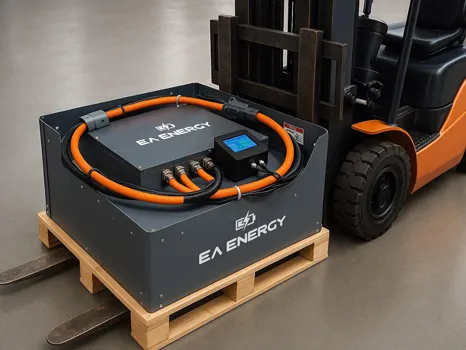
When a warehouse operator in Vietnam asked us to convert 20 Yale reach trucks from lead acid to lithium, the battery was the easy part. The hard part was everything around it: matching a 921 kg lead-acid block dimension for dimension, keeping the truck's ballast inside the manufacturer's weight window, and giving one site a way to actually manage 20 batteries at once.

Yale NDR035EC pantograph reach truck operating in the customer's high-bay warehouse in Vietnam.
When a warehouse operator in Vietnam asked us to convert 20 Yale reach trucks from lead acid to lithium, the battery was the easy part. The hard part was everything around it: matching a 921 kg lead-acid block dimension for dimension, keeping the truck's ballast inside the manufacturer's weight window, and giving one site a way to actually manage 20 batteries at once.
This is the full engineering story behind the EA36840F — a custom reach truck lithium battery designed and built by EA ENERGY as a true drop-in replacement for the 36 V flooded lead-acid pack in a Yale NDR035EC-18.25 pantograph reach truck.
The pack is 38.4 V, 840 Ah LiFePO4, 965 × 455 × 780 mm, 920 kg with a steel ballast base, charged by a 100 A overnight charger and monitored over 4G from a single dashboard.
Specification | EA36840F |
Battery model | EA36840F (custom) |
Chemistry | LiFePO4 (LFP) |
Nominal voltage | 38.4 V (12S) — replaces 36 V / 18-cell lead acid |
Capacity | 840 Ah |
Nameplate energy | 32.3 kWh |
Usable energy | ~30.6 kWh (≈95% depth of discharge) |
Finished weight | 920 kg (2,028 lb), incl. steel ballast base |
Dimensions | 965 × 455 × 780 mm |
Charger | 100 A / ~4.4 kW, lithium-specific (≈0.12C) |
Connectivity | 4G + mobile APP + cloud dashboard + remote OTA |
Fleet | 20 trucks, single site, Vietnam |
Executive summary. A Vietnamese operator needed 20 Yale NDR035EC-18.25 reach trucks moved from flooded lead acid to lithium without modifying the trucks. EA ENERGY delivered the EA36840F: a 38.4 V 840 Ah LiFePO4 pack at the original 965 × 455 × 780 mm envelope, ballasted to 1,100 kg to stay inside Yale's weight window, charged overnight at a gentle 100 A, and managed remotely over 4G so a 20-truck site runs as one fleet. The result is lower lifetime cost, no battery room, and full visibility of every pack.
Everything starts with the data plate. For a custom lithium conversion, the nameplate is not a formality — it tells you the voltage class, the maximum capacity the truck is rated for, and, critically, the weight window the battery has to sit inside.
Parameter | Value |
Model / battery compartment | NDR035EC-18.25 (18.25 in compartment) |
Battery voltage class | 36 V (18 lead-acid cells) |
Rated capacity at 24 in (610 mm) load centre | 3,500 lb (1,588 kg) |
Truck weight without battery | 3,290 kg (7,240 lb) |
Truck weight with maximum battery | 4,560 kg (10,040 lb) |
Allowable battery weight (per truck data plate) | 1,000 – 1,270 kg (2,200 – 2,800 lb) |
Maximum 6-hour rate, 18.25 in compartment | 1,085 Ah / 38.1 kWh |
Wheelbase / base width | 1,641 mm (64.6 in) / 1,302 mm (51.3 in) |
Attachment | 825 mm (32 in) ISS1-42 in carriage + 1,219 mm (48 in) forks |
And the pack we were replacing — a HAWKER® Perfect Plus flooded traction battery:

HAWKER® 18-8PZB840 · 36 V · 840 Ah at C5 · 18 × 8PZB840 cells · electrolyte 1.29 kg/L · 921 kg
Three numbers from that label do all the work in this project: 36 V, 840 Ah and 921 kg. A lithium replacement has to respect all three — the first two for performance, the third for safety.
The customer's situation is typical of large distribution centres across Southeast Asia. One site. Twenty reach trucks. Two shifts. A battery room that was built years ago and is now the most congested, least flexible part of the building.
The single biggest driver of lead-acid failure is heat. Every 10 °C above 25 °C roughly halves the service life of a flooded traction cell. In a Vietnamese warehouse that regularly sits at 35–40 °C, a pack rated for 4–5 years in a temperate market can be done in 2–3. That is the difference between replacing a fleet once and replacing it twice.
An 840 Ah flooded pack means a lot of cells to top up, and topping up is a weekly, disciplined task. Multiply it by 20 trucks and you have a permanent maintenance roster, plus the cost of distilled water, plus the risk of an operator forgetting and boiling a cell dry.
Flooded cells vent hydrogen. That means ventilation, extraction, an acid-resistant floor, a dedicated charging zone away from stored goods, eyewash stations and PPE. In a market where warehouse floor space is expensive, the battery room is dead space that you paid for and cannot use.
Flooded lead acid does not like opportunity charging, so most multi-shift operations buy a second pack for every truck and swap it — which doubles the capital tied up in lead, and adds a change cart and hoist to the fleet.
This is the point most conversion projects get wrong. A reach truck uses its battery as ballast. Replace a 921 kg lead block with a much lighter lithium pack and you have quietly changed the truck's stability envelope and its load chart.
With lead acid the battery is a black box. It works until it does not. Nobody knows which truck is down to 60% capacity, which cell is drifting, or when the fleet is going to start dying mid-shift. For a site with 20 vehicles and a service organisation far away, that is the expensive kind of unknown.
After reviewing the truck data plate, the original battery label and the customer's operating pattern, the brief came down to five requirements:
1. Fit the customer's own warehouse use case in Vietnam — a stand-alone site, not a resale project.
2. 38.4 V, 840 Ah, with steel ballast in the base, bringing the finished pack to 920 kg, so the truck never runs underweight.
3. Model EA36840F, charged by a 100 A unit — deliberately slow, because the trucks are idle all night.
4. Dimensions taken exactly from the original lead-acid battery: 965 × 455 × 780 mm, no modification to the truck.
5. A back-end management platform over 4G, with an APP and remote firmware upgrade, so 20 batteries can be supervised and serviced as one fleet.
The fastest way to make a conversion project fail is to make the truck fit the battery. So we did the opposite: the EA36840F is built to the original lead-acid envelope, 965 × 455 × 780 mm, with the original roller positions, the original retention points and the OEM 350 A gray connector.

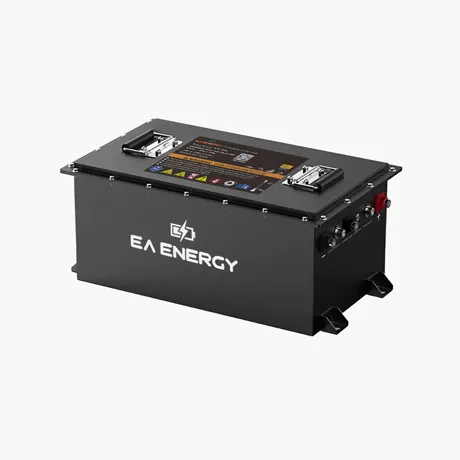
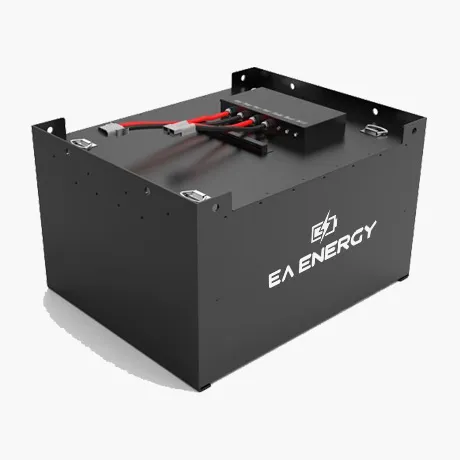
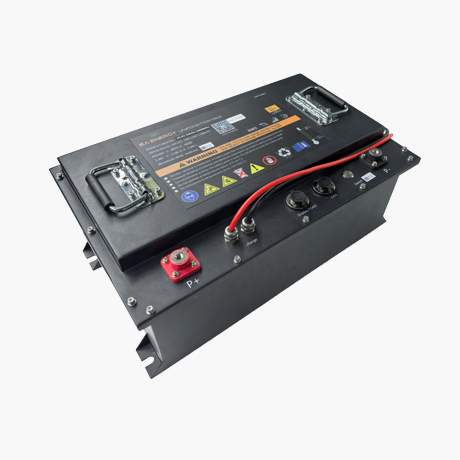
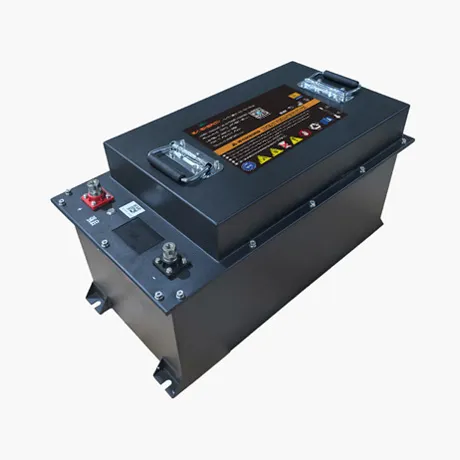
The finished EA36840F on the inspection floor, measured against the drawing before crating: 965 × 455 × 780 mm, steel enclosure, two power cables, the OEM-style gray connector, lifting eyes and the BMS/service label on the top cover. Cables are routed to the OEM exit point so the pack can be lifted straight into the truck.
Dimensions on their own prove nothing, so we checked the finished drawing against the battery compartment data in Yale's own specification for this truck (spec sheet 2015YBC2SP002_E_EN-US, 18.25 in compartment):
Check | OEM compartment limit | EA36840F | Result |
Length (X) | 990 mm max | 965 mm | Inside the envelope |
Width (Y) | 464 mm max | 455 mm | Inside the envelope |
Height (Z) | 800 mm max | 780 mm | Inside the envelope |
Finished weight | 998 – 1,270 kg (2,200 – 2,800 lb) | 920 kg | Inside the window, with margin |
Fitting | Fixed lifting eyes, no cover | Lifting eyes as standard | No modification to the truck |
Two things are worth pointing out here. First, the pack sits inside the compartment envelope rather than being forced into it, which is what lets a customer's own maintenance team lift it out with the equipment they already own. Second, the compartment is rated for a maximum 6-hour rate of 1,085 Ah / 38.1 kWh, so an 840 Ah pack is a comfortable fit in both senses — physically and electrically.
Practically, that means:
No cutting, no welding, no adapter plate, no new battery tray.
The truck's wheelbase, headlength, turning radius and load chart are unchanged, because nothing structural moved.
One operator, one forklift and roughly the same lifting routine as the lead-acid pack it replaces.
If the site ever wants to go back, the lead-acid pack still fits. Buyers care about that.

The CAD model the customer signed off before a single cell was welded: enclosure, the two fixed lifting eyes the compartment expects, the connector plate on the top cover, and the ballast assembly hidden in the base. Every conversion starts here rather than on the production line, which is how a 20-unit order ships without a single fitment surprise.
Why the enclosure is steel, not plastic. A steel enclosure is heavier, but it is the right answer for an industrial truck. It protects the cells from impact in an aisle, it acts as part of the ballast itself, and it gives the mounting points the stiffness a steel battery compartment expects. It is also why a 32 kWh pack can be delivered at a guaranteed, measurable finished weight rather than an estimate.
Here is the counter-intuitive part of this project: the lithium pack is heavier than the lead-acid pack it replaces. That is deliberate, and it is the single most important safety decision in the design.
Start with the physics. A reach truck carries the battery between the drive wheel and the load wheels. The battery is the counterweight that keeps the truck planted when the mast is extended, the carriage is 10 metres up and the load centre is 610 mm forward. Remove mass and you reduce the truck's residual capacity and its tip-over margin — quietly, and without any warning light.
Yale's own specification for the 18.25 in battery compartment sets the allowable battery weight at 1,000 – 1,270 kg (2,200 – 2,800 lb). The original HAWKER pack is labelled 921 kg. Now consider what a bare LiFePO4 pack of the same 840 Ah capacity weighs: with modern prismatic cells at roughly 110–130 Wh/kg at pack level, a 32.3 kWh pack lands somewhere around 300 kg — about a third of the lead block.
Drop that into the compartment and you have taken more than 600 kg of ballast off the back of a 3.5-tonne reach truck. The truck will still drive. It will just no longer be the truck on the load chart. A reach truck lithium battery that is too light is not an efficiency gain — it is an unapproved modification to the truck's stability.
Option | Battery weight | Against Yale's 1,000–1,270 kg window |
Original HAWKER 18-8PZB840 lead acid | 921 kg | ~79 kg below the minimum |
Bare LiFePO4, 32.3 kWh, no ballast | ~300 kg | Far below the minimum — not acceptable |
EA36840F with steel ballast base | 920 kg | Inside the window, with margin |
So we designed ballast in from the start: a machined steel plate assembly bolted into the base of the enclosure, sized so the finished, ready-to-install pack weighs 920 kg. That sits comfortably inside the manufacturer's window, restores the truck's stability margin, and keeps the load chart valid. It is also about 180 kg heavier than the pack that came out — which, on a reach truck, is not a penalty. It is insurance.
A useful side effect: a lower centre of gravity. Because the ballast sits in the base of the pack, the mass is concentrated low. The result is a pack whose centre of gravity is lower than a uniform lead-acid block of the same weight. You get the ballast back without raising the centre of gravity — the opposite of what most people assume when they hear "extra steel".
The customer's warehouse is dormant from early evening to early morning. Nobody is picking. Nobody needs a truck at 02:00. So the question was never "how fast can we charge?" but "what is the gentlest charge profile that still finishes before the first shift?"

The answer for an 840 Ah pack is a 100 A charger:
Charge rate: 100 A ÷ 840 Ah ≈ 0.12C — a genuinely gentle charge.
Time to full: about 8.4 hours at constant current, plus a short constant-voltage taper → roughly 9–10 hours from empty. That fits an overnight window with room to spare for a late-finishing second shift.
Power draw: 100 A × ~44 V ≈ 4.4 kW — modest enough to run a 20-truck rotation off the site's existing supply.
Low-C-rate charging matters more than most buyers realise. Charging slowly generates less internal heat and less mechanical stress on the cell, which is exactly what protects cycle life over a 6–8 year horizon. Fast charging is a tool for operations that cannot stop. This customer can stop, so we spent the headroom on battery life instead of on speed.
Do not reuse the old lead-acid charger. A flooded lead-acid charger finishes on a gassing/equalising profile that LiFePO4 cannot tolerate, and its BMS expects a charger that talks to it. Every conversion we ship includes a lithium-specific charger with the correct 12S LiFePO4 profile and a communication handshake with the pack. It is the one component you must replace.
What you gain immediately is the disappearance of everything around the old charger: no watering, no equalising charges, no acid film on the terminals, no gassing. Charging stops being a controlled activity in a dedicated room and becomes something that simply happens overnight, next to the racking.
The customer's own words when we scoped the project: our site is large, we run a lot of vehicles, and managing them is a mess.
That is a fleet-management problem, not a battery problem — and it is the reason the EA36840F ships with a 4G module and a cloud gateway as standard equipment rather than as an accessory.
What the customer sees
One dashboard for the whole fleet. Every pack reports state of charge, pack and cell-group voltage, current, temperature, cycle count and state of health.
Live status per truck. Which vehicle is charging, which is working, which one is sitting at 25% and about to strand a picker.
Alarms pushed to the APP. Over-temperature, over/under-voltage, cell imbalance, insulation faults, abnormal self-discharge, communication loss — delivered to a phone, not discovered at the end of a shift.
History. Charge and discharge curves per truck, so a degrading pack can be identified months before it fails.
Remote firmware upgrade (OTA). Update one battery, one group or all 20 from a browser. No engineer travels to site, no truck is taken out of service, and every unit is guaranteed to run the same firmware version.
What the data actually looks like.
This is not a concept — the platform is running on the customer's packs today, and it reads like this:

The fleet view — one line per battery, refreshed continuously: device time, heartbeat, wake-up signal, system status, state of charge, state of health, pack voltage, current and insulation resistance. Scanning twenty lines like this takes seconds; walking a battery room takes an hour.

A live charging session recorded on 20 September 2026. Pack voltage 40.2 V, charge current 102.6 A, cell voltage spread 3.366 V / 3.342 V (24 mV), cell temperature 34–35 °C.
Three numbers in that chart are worth pausing on, because they are the whole argument for the 100 A charger in one picture:
102.6 A of charge current. The charger is running at its rated output and the pack is taking it without complaint.
A 1 °C spread between the hottest and the coldest cell group while charging. There is no hot spot being pushed through this pack, which is exactly what protects cycle life over a six-to-eight-year horizon.
A 24 mV spread across the 12 series cell groups (3.366 V max, 3.342 V min). That is a balanced, well-matched pack — and it is the reason state of health still reads 100%.

Device records for the same pack: BMS model, serial number, software version and lifetime charge/discharge counters (342 Ah in, 181 Ah out, online rate 100%), with the 4G DTU below — model, IMEI, ICCID, network validity and APN. This is the page that turns a warranty conversation into a two-minute data check.
Why this matters even more in an export market. For a customer in Vietnam buying from a manufacturer thousands of kilometres away, after-sales is usually the weak link in the chain. Remote diagnostics turn most service events into a data query instead of a site visit: we can read the fault, check the cell data, decide whether it is a configuration issue, a charger issue or a genuine hardware issue, and act accordingly. That is faster for the customer and cheaper for everyone.
Parameter | Flooded lead acid (18-8PZB840) | LiFePO4 (EA36840F) |
Nominal voltage | 36 V (18 × 2 V) | 38.4 V (12S) |
Rated capacity | 840 Ah @ C5 | 840 Ah |
Nameplate energy | 30.2 kWh | 32.3 kWh |
Usable energy | ~24 kWh (80% DoD, less once Peukert losses are counted) | ~30.6 kWh (≈95% usable) |
Finished weight | 921 kg | 920 kg (steel-ballasted, on purpose) |
Dimensions | 965 × 455 × 780 mm | 965 × 455 × 780 mm |
Watering | Weekly, every cell | None |
Equalising charge | Required | Not applicable |
Gassing / ventilation / acid handling | Required | None |
Charging efficiency (typical) | 70–80% | ~95% |
Cycle life (typical) | 1,200–1,500 cycles | 3,000–4,000+ cycles |
Realistic service life, hot climate | 2–4 years | 6–8+ years |
Battery changes per shift | Common | Not needed |
Remote monitoring | None | 4G, APP, OTA |
The headline is not the voltage. It is the usable energy. Lead acid is normally discharged to about 80% depth of discharge and gives back less than its nameplate figure at real-world discharge rates. LiFePO4 runs to roughly 95% depth of discharge with almost no rate penalty. On the same nominal 840 Ah, that is roughly a quarter more work per charge — which is why an 840 Ah lithium pack comfortably replaces an 840 Ah lead-acid pack and still leaves the truck more runtime, not less.
The savings split into six parts — and the first one (electricity) is the figure most buyers underestimate.
Flooded lead acid returns roughly 70–80% of the energy you put into it; LiFePO4 returns about 95%. Run the numbers on a 20-truck fleet and the gap is not small. Using the customer's duty cycle as an illustration:
20 trucks × ~30 kWh usable per day = 600 kWh delivered
At 75% charging efficiency → 800 kWh drawn from the grid
At 95% charging efficiency → 632 kWh drawn
Saving ≈ 170 kWh per day, or roughly 5,000 kWh per month
At an industrial tariff in the region of USD 0.08/kWh, that is in the order of USD 400 per month — about USD 4,800 a year, from efficiency alone. Your numbers will differ with tariff, duty cycle and shift pattern, but the direction is fixed: lithium wastes less of what you buy.
With overnight charging capable of fully refilling the pack, there is no need for a second set of batteries per truck — no spare packs, no battery-change cart, no hoist, no change bay. On 20 trucks that is a substantial amount of capital that simply does not need to be spent.
Watering, equalising, terminal cleaning, corrosion treatment, battery changes and the supervision that goes with all of it. This is the cost that never appears in a battery quotation and always appears in an operating budget.
1,200–1,500 lead-acid cycles versus 3,000–4,000+ for LiFePO4, on top of the extra lifetime penalty a hot climate imposes on lead acid. Over an 8-year horizon, most fleets face two to three lead-acid pack replacements against a single lithium pack.
No charging room, no hydrogen extraction, no acid spill kit, no eyewash station in a corner. The floor space comes back, and the safety file gets shorter.
A battery that reports its own faults is a battery that gets repaired during a planned window instead of during a picking peak. On a 20-truck site, avoiding one stalled shift is often worth more than a month of electricity savings.
Add those up and the switch is not really a battery purchase. It is a five-to-eight-year operating cost decision — which is exactly how a reach truck lithium battery should be evaluated.
This project was a reach truck lithium battery conversion, but the same engineering method applies across the material-handling and off-highway world EA ENERGY builds for every day:
Forklifts — counterbalance, three- and four-wheel, cushion and pneumatic
Reach trucks and order pickers — single reach, double reach, low-level and high-level
Pallet trucks and stackers — powered pallet trucks, tow tractors, AGVs
Aerial work platforms — scissor lifts and boom lifts, the class we build in the largest volumes
Marine and specialty electric vehicles — boat and tender traction packs, golf and utility vehicles
Voltage classes run from 24 V through 36 V, 38.4 V, 48 V, 72 V and 80 V, with capacities from roughly 100 Ah to 1,400 Ah. We build to DIN, BS, JIS and GB tray standards, and we have matched OEM battery compartments across the major truck brands. Because every project starts from the customer's actual data plate and compartment drawing, no two packs we ship are quite the same — and that is the point.
The questions we are asked most often about this conversion.
Yes. A 36 V lead-acid system uses 18 cells at 2 V nominal, and the standard lithium equivalent is a 12S LiFePO4 pack at 38.4 V nominal (43.8 V full charge), which sits inside the operating window of the truck's 36 V controller and its OEM 350 A connector. On the Yale NDR035EC-18.25 in this project, the EA36840F drops into the original battery compartment with no modification to the truck.
A 38.4 V 840 Ah LiFePO4 pack. You do not need to oversize it to match the lead-acid figure, because usable energy is what matters: lead acid is typically discharged to about 80% depth of discharge with additional capacity loss at higher discharge rates, while LiFePO4 delivers roughly 95% of its rated capacity. In this project the 38.4 V 840 Ah pack provides about 32.3 kWh nameplate and roughly 30.6 kWh usable, replacing a 36 V 840 Ah lead-acid pack whose usable energy was closer to 24 kWh.
Because a reach truck uses its battery as counterweight. The battery sits between the drive wheel and the load wheels and is what keeps the truck stable when the mast is extended with a load at a 610 mm load centre. Yale specifies an allowable battery weight of 1,000–1,270 kg for the 18.25 in compartment of this truck. A bare 32 kWh LiFePO4 pack weighs only around 300 kg, so fitting one without ballast would take more than 600 kg off the truck and reduce both its residual capacity and its tip-over margin. Our EA36840F therefore includes a steel ballast plate in the base that brings the finished pack to 920 kg — inside the manufacturer's window — while keeping the centre of gravity low.
About 9–10 hours from empty: roughly 8.4 hours at constant current plus a short constant-voltage taper. That is a charge rate of about 0.12C, which is gentle enough to protect cycle life and still finishes well inside an overnight window. The charger draws roughly 4.4 kW.
No. Flooded lead-acid chargers finish on a gassing and equalising profile that LiFePO4 cannot tolerate, and they do not communicate with a lithium BMS. Every conversion we supply includes a lithium-specific charger with the correct 12S profile and a handshake with the pack. This is the one component that must be replaced rather than reused.
Typically 3,000–4,000+ cycles, which in a single-shift operation usually means 6–8 years or more, compared with roughly 1,200–1,500 cycles for flooded lead acid. Life depends on depth of discharge, temperature and charge rate — which is one reason we size the charger conservatively and keep the BMS reporting temperature and cycle data.
Yes. The pack includes a 4G module and a cloud gateway. Operators see state of charge, voltage, current, temperature, cycle count, state of health and alarm history per truck in a browser dashboard or the mobile APP, and firmware updates can be pushed remotely to one unit or an entire fleet. For customers buying from overseas, this is the fastest route to after-sales support, because most issues can be diagnosed from the data without a site visit.
Yes. For the 18.25 in compartment, the Yale specification for this truck allows a battery envelope of up to 990 × 464 × 800 mm and an allowable battery weight of 998–1,270 kg (2,200–2,800 lb). The EA36840F measures 965 × 455 × 780 mm and weighs 1,100 kg finished, so it sits inside both the dimensional envelope and the weight window — and it keeps the fixed lifting eyes the compartment is designed for, which means no modification to the truck.
Yes — this is most of what we do at EA ENERGY. We regularly build to the data plates and battery compartments of the major truck brands, in 24 V, 36 V, 38.4 V, 48 V, 72 V and 80 V classes and from about 100 Ah to 1,400 Ah, for forklifts, reach trucks, pallet trucks, order pickers, aerial work platforms and marine applications. Send us a photo of the data plate and the battery label via www.eabattery.com and we will size the pack, calculate the ballast and quote the charger with it.
EA ENERGY designs and manufactures custom lithium traction batteries for forklifts, reach trucks, pallet trucks, aerial work platforms and marine applications in 24 V to 80 V classes. Send us a photo of your truck's data plate and the label on the battery you are replacing, and we will come back with a sized, weighed and costed lithium proposal — including the ballast calculation, the CAD model and the right charger — for your voltage class and duty cycle.
Data sources: customer truck data plate (Yale NDR035EC-18.25, serial E861N0129V); original battery label (HAWKER Perfect Plus 18-8PZB840); Yale spec sheet 2015YBC2SP002_E_EN-US_v2R3 for the NR/NDR 030-045EC range; EA ENERGY cloud platform records for the packs delivered on this project.
Compatibility note: Yale® is a trademark of Hyster-Yale Group, Inc. HAWKER® is a trademark of EnerSys. Brand and model references are used for compatibility identification only and do not imply any affiliation or endorsement.
Published by EA ENERGY · www.eabattery.com
This is the first one.
 English
 Lithium Golf Cart Battery
 Low Speed Vehicle Battery
 Lithium Forklift Battery
 Aerial Work Platform Battery
 Floor Cleaning Machine Battery
 Lithium Marine Battery
 Residential ESS
 Commercial & Industrial ESS
 Truck Electrical System
 RV Electrical System