When a major logistics service provider in Canada looked at its fleet of 50 Toyota 9BDRU15 double reach trucks, the numbers told a familiar story. The original 36V lead-acid batteries — once the backbone of the operation — were fading fast. Runtimes were shrinking, charging rooms were congested, and maintenance crews were spending more time nursing batteries than moving freight.
The company didn't want a compromise. They wanted the maximum possible battery capacity inside the original battery compartment, charging fast enough to kill the battery-swap routine, and full visibility into every pack across the fleet. This is the story of how the EA ENERGY EA36990F — a custom-engineered 38.4V 990Ah LiFePO4 battery — delivered exactly that, across all 50 trucks.
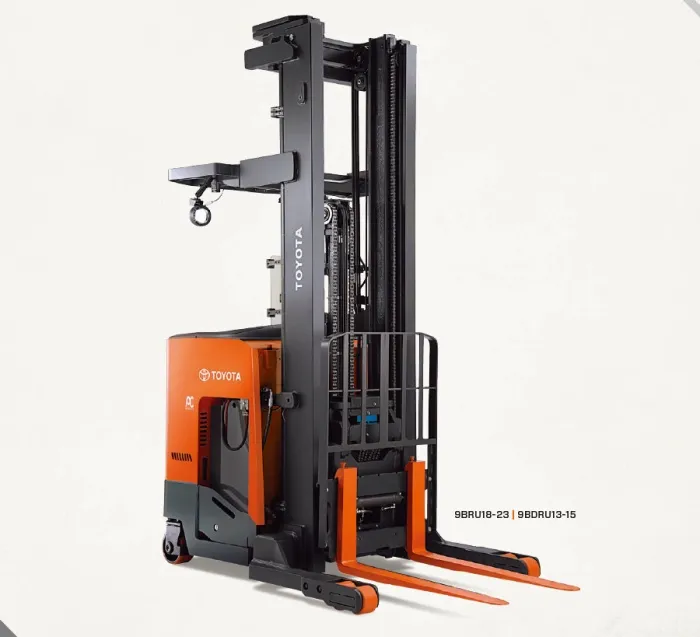
Reach trucks are the workhorses of high-bay warehouses — and they're brutally demanding on batteries. The 9BDRU15 is Toyota's 3,000 lb double reach truck, built for narrow aisles and lift heights up to 366 inches; mast elevation, deep double-reach cycles, and long travel distances at height drain energy fast. By the time this Canadian operator came to us, their 36V lead-acid packs were showing every classic symptom of end-of-life:
Collapsing runtime: Batteries that once lasted a full shift were dying by mid-afternoon, forcing mid-shift swaps and unplanned downtime.
The charging bottleneck: Each lead-acid pack needed roughly 8 hours to charge plus cooling time. Keeping 50 trucks running across multiple shifts meant owning — and constantly swapping — far more than 50 batteries.
Maintenance drag: Weekly watering, equalization charges, acid spills, and corroded terminals consumed technician hours every single week.
Lost warehouse space: A dedicated battery room with ventilation, hoists, and spill containment was eating floor space that could have held revenue-generating pallet positions.
Zero visibility: With lead-acid, the only way to know a battery's condition was when a truck stopped working. No state-of-health data, no early warnings, no records.
The fleet needed more than new batteries. It needed a new energy strategy.
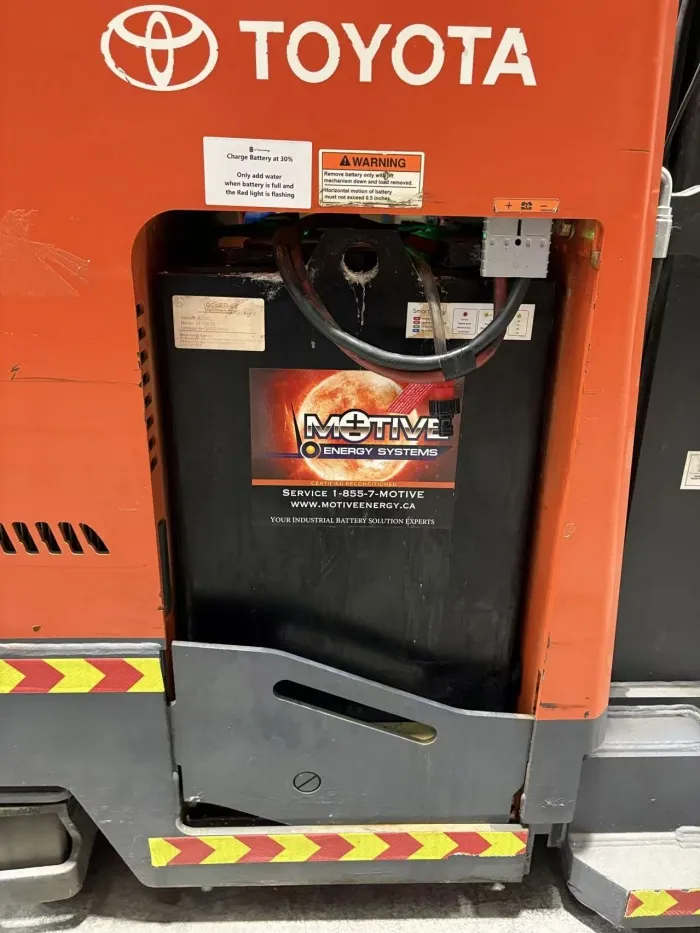
The customer's first requirement was non-negotiable: keep the original battery dimensions and squeeze in as much capacity as physically possible. No compartment modifications, no tray adapters, no compromises on fit.
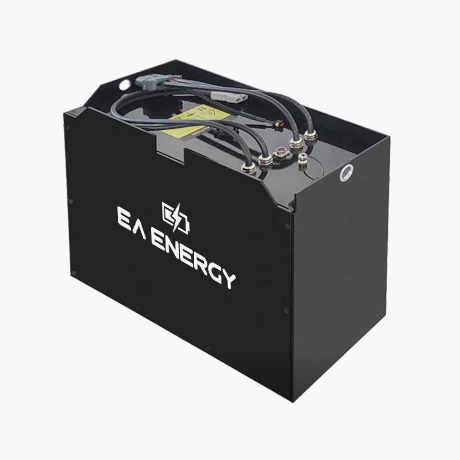
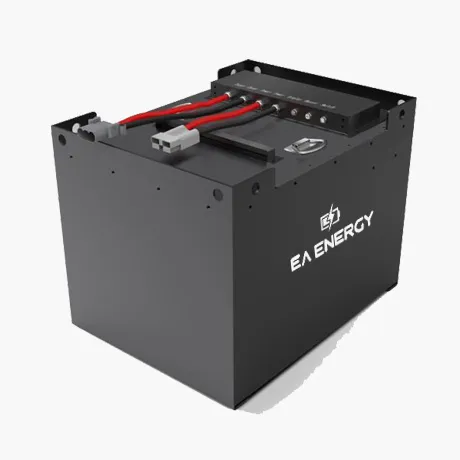
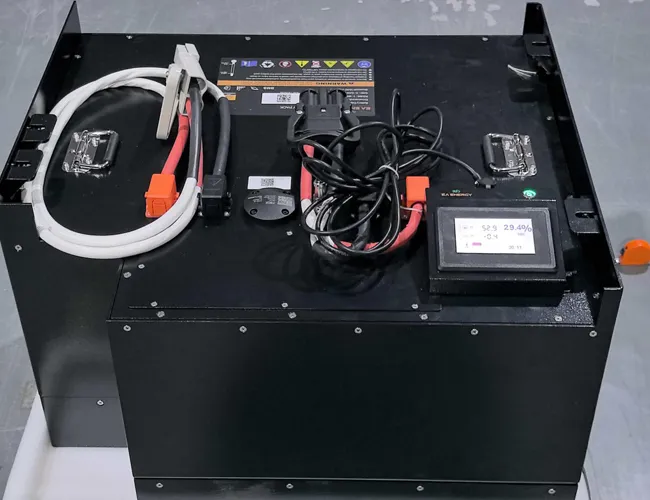
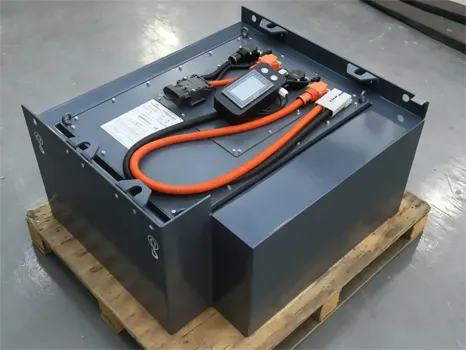
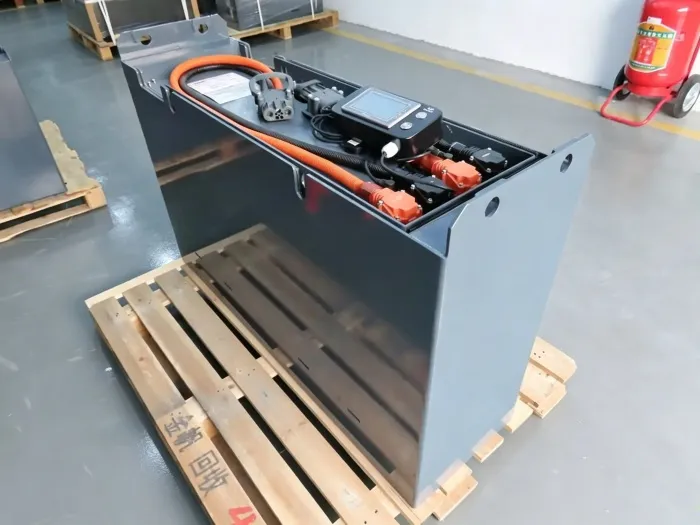
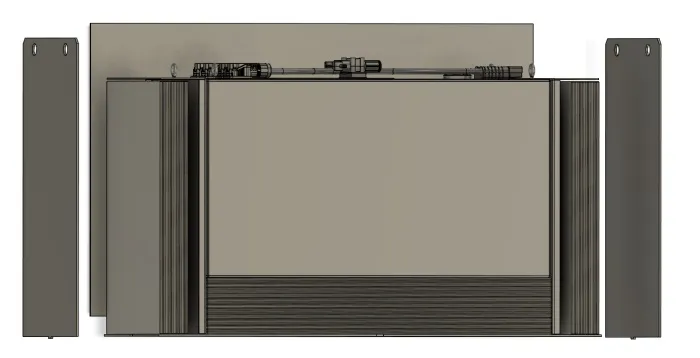
Our engineering team worked from Toyota's official 9BDRU15 specification sheet, engineering the pack around the OEM enclosed battery compartment. The result: the EA36990F, a 38.4V 990Ah LiFePO4 battery built on a 12S configuration, measuring 965 × 450 × 780 mm — a precision fit for the original compartment, with every available millimeter filled with lithium iron phosphate cells. It delivers approximately 38 kWh of stored energy in the same space that once held the lead-acid pack.
Because lithium iron phosphate cells pack dramatically more energy per liter than lead-acid — and because the pack needs no watering headroom, no vented caps, and no excess clearance for acid handling — the usable energy more than doubled without changing a single dimension of the truck.
Specification | Value |
Model | EA36990F |
Compatible Truck | Toyota 9BDRU15 double reach truck (3,000 lb class) |
Chemistry | LiFePO4 (Lithium Iron Phosphate) |
Configuration | 12S |
Nominal Voltage | 38.4V |
Rated Capacity | 990Ah |
Stored Energy | ~38 kWh |
Usable Energy (95% DoD) | ~36 kWh |
Cycle Life | 4,000+ cycles |
Dimensions (L × W × H) | 965 × 450 × 780 mm — engineered to the OEM battery compartment |
Total Weight (pack + counterweight) | 1,100 kg — meets OEM weight specification |
Charger | 43.8V / 200A fast charger |
Telematics | Integrated GPS + 4G module |
Fit | Drop-in, identical to OEM battery dimensions |
Many lithium conversions force a trade-off: either accept a smaller, lighter pack that wastes compartment space, or modify the truck. This project proved there's a third option. By engineering the pack to the OEM envelope and optimizing the internal cell layout, the customer got the largest energy capacity the compartment could physically hold — translating directly into the longest possible runtime per charge. For a 50-truck fleet running tight shifts, those extra hours per charge are the difference between a smooth operation and a daily game of battery roulette.
On a reach truck, the battery isn't just a power source — it's ballast. The truck's stability at full mast extension depends on the battery assembly meeting the OEM's weight specification, which is one reason fleet managers hesitate to abandon heavy lead-acid packs.
The EA36990F solves this by design. Despite lithium cells being far lighter than lead-acid, the pack integrates a purpose-built counterweight that brings the total assembly weight to exactly 1,100 kg — fully compliant with the Toyota 9BDRU15's original battery weight requirement. Stability curves, mast ratings, and load charts remain exactly as the OEM intended. No derating, no stability compromise, no re-certification headaches — the truck behaves exactly as it did on lead-acid, just with more than double the usable energy on board.
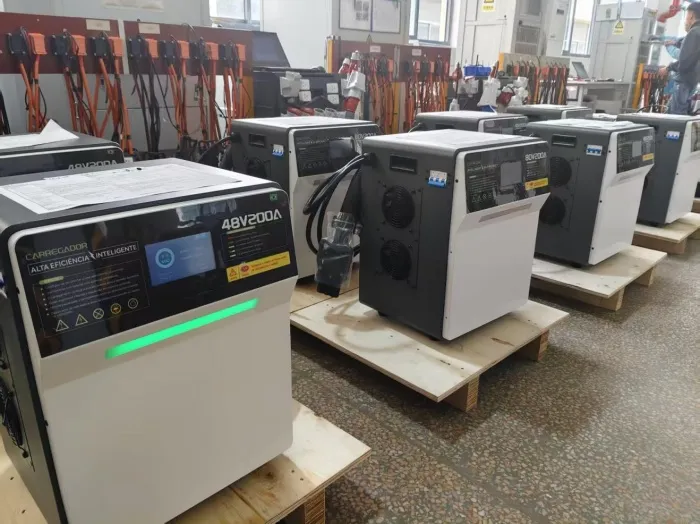
The second pillar of the solution was charging speed. Each pack is paired with a matched 43.8V / 200A charger — the 43.8V corresponding exactly to the 3.65V per-cell charge ceiling across the 12-series architecture.
What this means on the warehouse floor:
Opportunity charging becomes the operating model. Operators plug in during breaks, lunch, and shift changes. Fifteen to thirty minutes on the charger puts meaningful energy back into the pack — something lead-acid chemistry simply cannot tolerate.
One battery per truck, not two or three. The old model of rotating spare lead-acid packs through a battery room disappears. Each reach truck keeps its own lithium pack, period.
Closed-loop safety. The charger and the pack's BMS communicate continuously. The battery management system tells the charger precisely how much current the pack can accept at any moment; if any cell approaches a voltage or temperature limit, current tapers automatically.
For a 50-truck fleet, eliminating the swap routine doesn't just save labor — it removes an entire category of safety incidents, connector damage, and downtime.
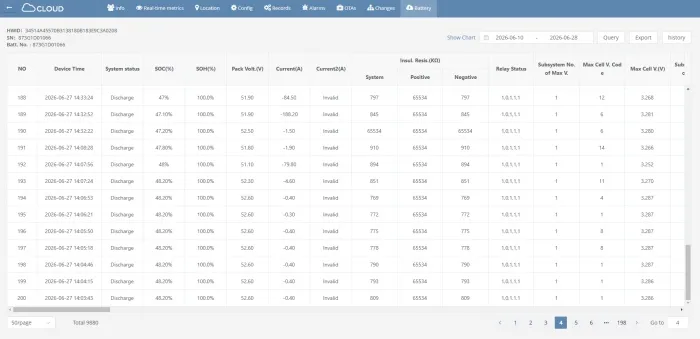
The third requirement was intelligence. Each battery ships with an integrated GPS and 4G communication module, turning every pack into a connected, data-reporting asset. From a dashboard, the fleet team can now:
Monitor real-time status: State of charge, state of health, voltage, current, temperature, and charge/discharge cycles for every one of the 50 packs — live, from anywhere.
Track location: GPS positioning shows where every battery is at all times — essential for multi-site operations and a powerful anti-theft and asset-accountability tool.
Receive proactive alerts: Abnormal temperature, low state of charge, or cell anomalies trigger notifications before they become breakdowns. Maintenance shifts from reactive to predictive.
Upgrade remotely: BMS firmware updates and parameter optimizations are pushed over the air — no site visits, no service calls, no downtime.
Analyze fleet-wide patterns: Charging behavior, energy consumption per truck, and utilization data reveal which trucks are overworked, which chargers are congested, and where the next efficiency gains hide.
For the operations team, this was the feature that changed how they think about batteries altogether: from consumables that fail silently to managed assets that report their own condition.
With all 50 Toyota reach trucks converted, the transformation showed up in every corner of the operation:
Runtime restored — and then some. With roughly 36 kWh of usable energy per charge (versus the effective 14–17 kWh the aging lead-acid packs were delivering at their managed 50–60% depth of discharge), trucks run full shifts on a single battery with capacity to spare.
The battery room shrank to a charging corner. No watering stations, no swap hoists, no acid containment. Fast chargers line a wall; that's the entire infrastructure.
Maintenance dropped to near zero. No watering, no equalization, no terminal cleaning, no acid handling. Technicians were reassigned to higher-value work.
Downtime became visible before it happened. Telematics alerts flag anomalies days before a failure would strand a truck mid-aisle.
The fleet is future-proof. With 4,000+ cycle life — roughly three times what lead-acid delivers in real-world material handling duty — these packs will outlast two or three generations of lead-acid replacements.
Factor | Original 36V Lead-Acid | EA36990F LiFePO4 |
Usable Energy per Charge | ~14–17 kWh (50–60% DoD) | ~36 kWh (95% DoD) |
Full Charge Time | ~8 hours + cooling | ~4.5–5 hours (200A) |
Opportunity Charging | Not recommended | Fully supported |
Batteries per Truck (multi-shift) | 2–3 | 1 |
Battery Weight Compliance | Inherent (heavy chemistry) | 1,100 kg with integrated counterweight — meets OEM spec |
Routine Maintenance | Weekly watering, equalization | None |
Cycle Life | 1,200–1,500 cycles | 4,000+ cycles |
Fleet Visibility | None | Real-time GPS + 4G telematics |
This project offers a template any warehouse or logistics operator can follow:
1. You don't have to accept less capacity when you switch to lithium. A custom-engineered pack matched to your OEM compartment can deliver dramatically more usable energy in the same space.
2. Charging strategy matters as much as the battery. A properly matched high-current charger turns opportunity charging into an operating model — and eliminates spare batteries.
3. Telematics pays for itself. Real-time GPS and 4G monitoring converts batteries from invisible consumables into managed assets with predictable maintenance and verifiable ROI.
4. Fleet-scale conversion is a multiplier. Converting 50 trucks at once unified the entire fleet on one battery platform, one charger type, and one monitoring dashboard — simplification that compounds every day.
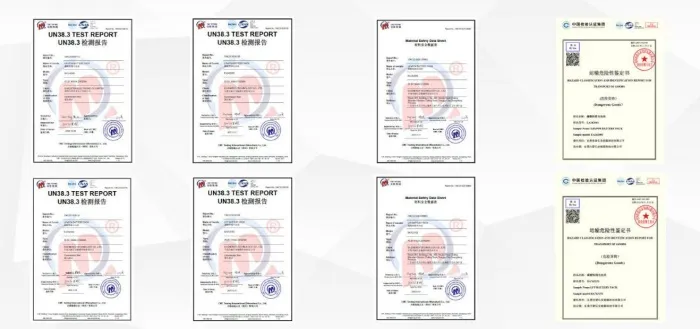
Every pack ships with a complete compliance package: UN38.3 test report, MSDS, DGM transport hazard assessments for sea, road, and air, Dangerous Goods Classification Report, plus CE and UL certifications. For this Canadian deployment, documentation cleared customs without delay — the same readiness we bring to every export market.
Fifty Toyota 9BDRU15 double reach trucks. One custom 38.4V 990Ah LiFePO4 battery — the EA36990F — built to the millimeter of the original compartment at 965 × 450 × 780 mm, and weighted to the kilogram of the OEM specification at 1,100 kg. A 200-amp fast charger that ended the battery-swap era. And GPS 4G telematics that put the entire fleet's energy data on one screen.
That's not a battery replacement — it's a fleet transformation.
If your reach trucks are still chained to aging lead-acid batteries, shrinking runtimes, and a battery room full of spares, the path this Canadian fleet took is open to you too. Contact the EA ENERGY team for a compartment assessment and a customized conversion plan for your fleet.
A: This deployment was engineered specifically for the Toyota 9BDRU15 double reach truck (3,000 lb class, 36V system). The pack measures 965 × 450 × 780 mm — a precision match to the OEM battery compartment — and weighs 1,100 kg including its integrated counterweight, meeting Toyota's original battery weight specification. The same custom-fit engineering process applies to other reach truck models, including the 9BRU18, 9BRU23, and 9BDRU13.
A: Yes. On reach trucks, battery weight is part of the stability equation, so the EA36990F integrates a purpose-built counterweight. The total assembly weighs 1,100 kg, fully meeting the Toyota 9BDRU15's OEM weight specification — stability, mast ratings, and load charts remain exactly as the manufacturer intended.
A: Yes. In this project, we engineered the EA36990F to the precise OEM battery compartment dimensions of the customer's Toyota 9BDRU15 trucks — 965 × 450 × 780 mm, a true drop-in fit with no modifications. Because LiFePO4 cells are far more energy-dense than lead-acid, the same footprint holds significantly more capacity.
A: The EA36990F stores approximately 38 kWh and supports 95% depth of discharge, delivering around 36 kWh of usable energy per charge. A comparable 36V lead-acid battery managed at 50–60% DoD delivers only about 14–17 kWh usable — so trucks typically gain more than double the runtime per charge.
A: It provides real-time remote monitoring of state of charge, state of health, voltage, temperature, and cycle counts for every battery; GPS location tracking for asset management and theft prevention; proactive alerts for abnormal conditions; and over-the-air BMS firmware upgrades — all accessible from a central dashboard.
A: With the matched 43.8V / 200A charger, a full charge takes approximately 4.5 to 5 hours, and the pack fully supports opportunity charging. Plugging in during breaks and shift changes keeps trucks running through multi-shift operations with a single battery.
A: Absolutely. The same custom-fit engineering process applies to 24V, 36V, 48V, and 80V platforms across all major forklift brands. We design each pack to your original compartment dimensions with the maximum capacity the space allows.
A: Every unit ships with a full documentation package including UN38.3 test report, MSDS, DGM transport hazard assessments, dangerous goods classification, and CE/UL certifications for European and North American markets.
This is the first one.
 English
  Lithium Golf Cart Battery
  Low Speed Vehicle Battery
  Lithium Forklift Battery
  Aerial Work Platform Battery
  Floor Cleaning Machine Battery
  Lithium Marine Battery
  Residential ESS
  Commercial & Industrial ESS
  Truck Electrical System
  RV Electrical System