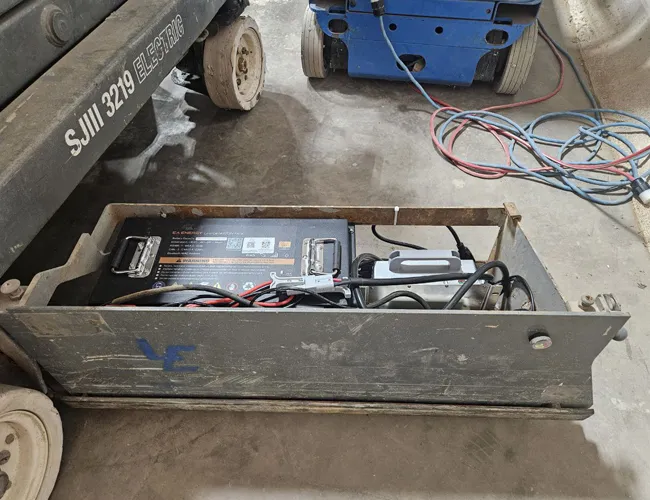
For a construction equipment rental company in the United States, the Genie GR-20 Runabout is one of those machines that never sits still. Compact, drivable at full height, and rated for a 7.9 m working height, it's the go-to vertical mast lift for electricians, HVAC contractors, and facility maintenance crews. But this rental fleet's GR-20s had a growing problem: their original lead-acid batteries had reached the end of their service life, and runtimes had collapsed to the point where customers were complaining — and returning machines early.
Short runtime on a rental machine isn't just a technical issue. It's lost revenue, service calls, unhappy customers, and a reputation problem. The fleet needed a battery that could last a full working day, survive the abuse of rental duty, and — critically for a rental business — give the company eyes on every machine, everywhere.
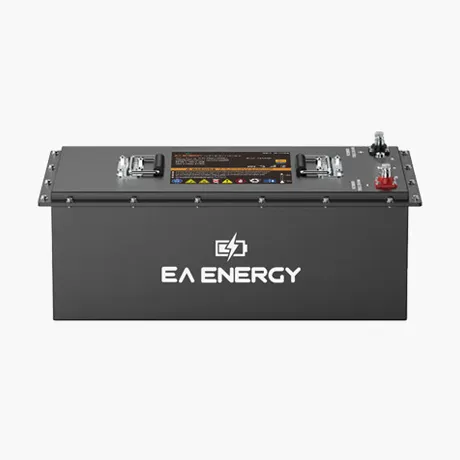
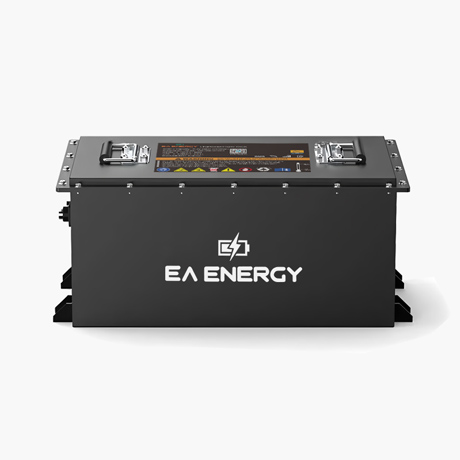
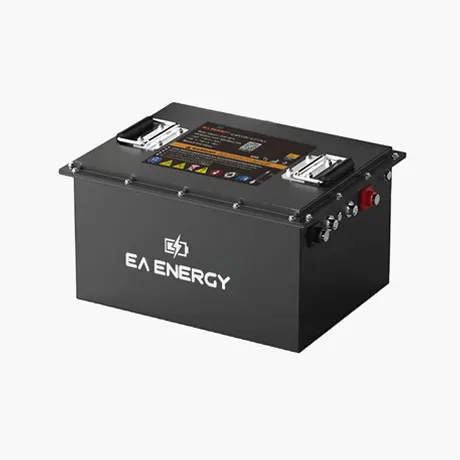
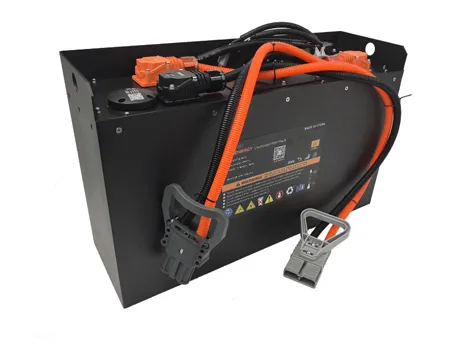
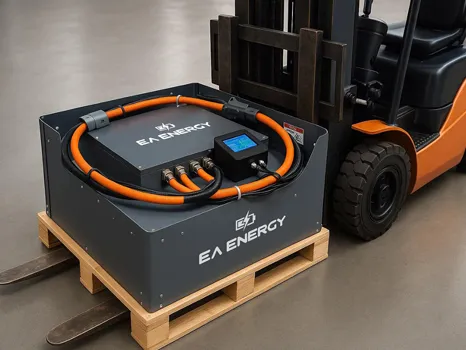
The answer was the EA ENERGY EA24230S: a 25.6V 230Ah LiFePO4 battery pack custom-engineered for the GR-20's battery compartment, backed by a 300A smart BMS, GPS 4G fleet monitoring with geofencing, and a low-voltage protection system designed specifically for aerial platform safety.
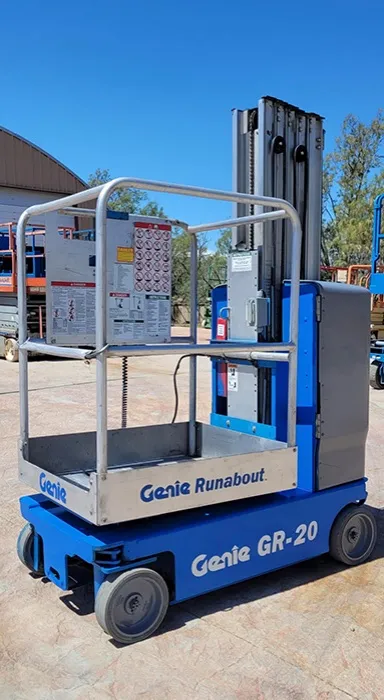
Anyone who runs a rental fleet knows what end-of-life lead-acid looks like up close. The symptoms across this GR-20 fleet were textbook:
Runtime measured in hours, not days. Customers renting a lift for an eight-hour job were calling by lunchtime — the machine wouldn't lift anymore. For a machine whose entire job is going up and down all day, that's a failed rental.
Constant service calls. Every stranded machine meant a phone call, a technician dispatch, or a swap-out trip. On a small vertical mast lift, one service call can erase the profit from an entire rental.
Charging logistics. Lead-acid packs needed overnight charging after every use, and customers on multi-day rentals couldn't be trusted to water batteries or charge them correctly. Chronic undercharging and sulfation accelerated the decline.
Zero asset visibility. Once a machine left the yard, the company had no idea where it was, how it was being used, or whether the battery was being abused. For rental equipment, that's money walking out the door.
The GR-20's original configuration — four 6V 225Ah lead-acid batteries for a 24V system — had served well enough when new. But with capacity fading across the fleet, it was time for a fundamentally better power source.
The customer provided the exact battery compartment dimensions — 20" × 14" × 12" — and our engineering team designed the pack to make full use of that envelope. The result is the EA24230S, a 25.6V 230Ah LiFePO4 battery measuring 495 × 297 × 200 mm, a precision drop-in for the GR-20's compartment with no machine modifications.
The GR-20, per Genie's official operator's manual, runs on a 24V system powered by four 6V 225Ah lead-acid batteries. The EA24230S replaces all four with a single integrated lithium pack built on an 8S configuration — and stores more usable energy in the process.
Specification | Value |
Model | EA24230S |
Compatible Machine | Genie GR-20 Runabout (vertical mast lift) |
Chemistry | LiFePO4 (Lithium Iron Phosphate) |
Configuration | 8S |
Nominal Voltage | 25.6V |
Rated Capacity | 230Ah |
Stored Energy | ~5.9 kWh |
Usable Energy (95% DoD) | ~5.6 kWh |
BMS Continuous Discharge | 300A |
Cycle Life | 4,000+ cycles |
Dimensions (L × W × H) | 495 × 297 × 200 mm — precision fit for the OEM 20" × 14" × 12" compartment |
Telematics | Integrated GPS + 4G module with geofencing |
Safety Feature | Low-voltage alarm with lift-motor lockout |
For reference, the machine itself, per Genie's published specifications:
Genie GR-20 (OEM Data) | Value |
Working Height (max) | 7.9 m |
Platform Height (max) | 6.1 m |
Platform Capacity | 159 kg |
Machine Weight | 1,112 kg |
OEM Power Source | 4 × 6V 225Ah lead-acid (24V system) |
OEM Charger Input | 85–264 VAC, 900 W |
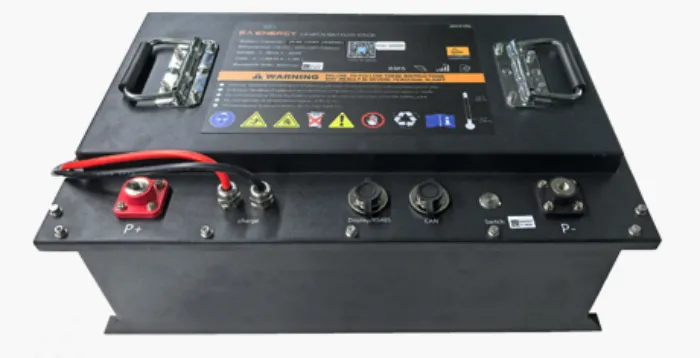
Here's the number that changed the customer's business: a fresh set of OEM lead-acid batteries (24V, 225Ah) stores about 5.4 kWh nominally, but lead-acid chemistry must be managed at 50–60% depth of discharge to avoid rapid degradation — leaving only about 2.7 to 3.2 kWh actually usable. The EA24230S stores ~5.9 kWh and safely discharges to 95% DoD, delivering roughly 5.6 kWh of usable energy per charge — close to double what even brand-new lead-acid could offer, and several times what the fleet's aged packs were delivering.
In practice, that means a GR-20 that used to die by mid-shift now works a full day of lifting, driving, and positioning — and plugs in overnight like a phone, with no watering, no equalization, and no battery room.
Genie's operator's manual is explicit: on GR-series Runabouts, the batteries serve as counterweight, and replacement batteries must not weigh less than the original equipment (Genie specifies a minimum of 28 kg per battery position). Because LiFePO4 cells are far lighter than lead-acid, the EA24230S is engineered with integrated ballast so the complete assembly meets the OEM weight requirement — preserving the machine's stability ratings exactly as Genie intended.
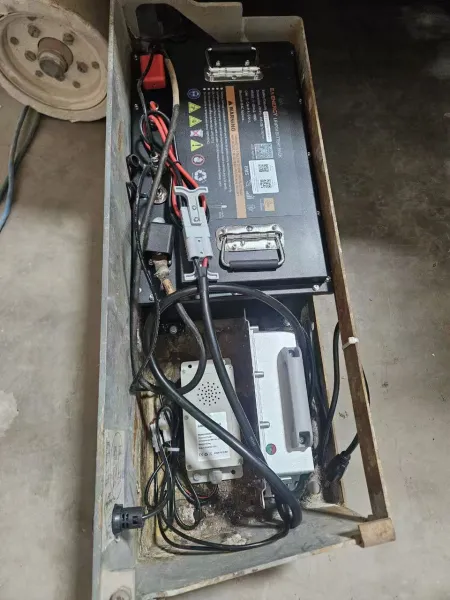
A vertical mast lift doesn't draw power gently. Driving to position, lifting at full speed, and running platform functions simultaneously creates real current demand. Based on field measurements of this fleet, the GR-20 draws 80–170A during typical operation, with peak discharge reaching approximately 270A at maximum power demand.
That's exactly why the EA24230S is built around a 300A continuous-discharge smart BMS — sized with deliberate headroom above the machine's 270A peak. The result:
No voltage sag under load. Even at full lift speed with the drive motors engaged, the pack delivers stable voltage — the machine performs the same at 30% charge as it does at 100%.
No nuisance shutdowns. Undersized BMS boards are the dirty secret of cheap lithium conversions — they trip at the exact moment the operator needs full power. A 300A ceiling means the BMS is never the bottleneck.
Multi-level protection. Overcharge, over-discharge, overcurrent, short-circuit, and temperature protection on every cell string, with active balancing to maximize pack life.
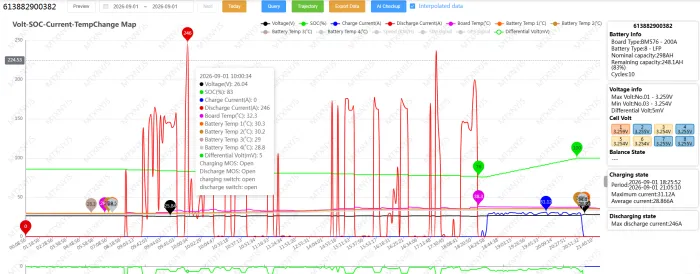
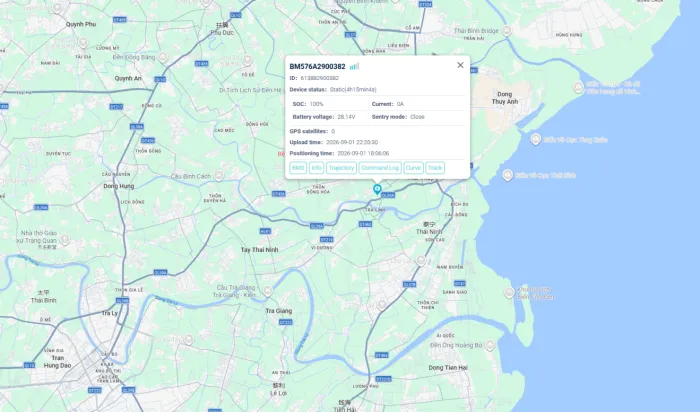
For a rental company, this is the feature that pays for itself. Every EA24230S carries an integrated GPS + 4G communication module, connecting each machine to a cloud dashboard where the fleet team can see, in real time:
Battery status: State of charge, state of health, voltage, temperature, and cycle counts for every machine in the fleet.
Live discharge current: See exactly how hard each machine is working — spot abuse, overloading, or a failing hydraulic system before it becomes a breakdown.
Machine location: Every GR-20 on the map, at all times. No more "the customer says it's on site somewhere."
Geofencing: Draw a virtual boundary around the job site or service territory. If a machine moves outside the fence — whether it's an unauthorized relocation or a theft in progress — the system alerts immediately.
For rental operations, geofencing and location tracking transform asset management: theft deterrence, faster recovery, verified on-site billing, and the end of machines disappearing into long-term unbilled limbo. Combined with live battery data, the company can now manage energy across the entire fleet from one screen — which machines need charging tonight, which customers are abusing equipment, and which units are ready to rent again right now.
Aerial work platforms have one failure scenario that keeps safety managers awake: an operator at height with a dead battery. Beyond the safety risk, chronic deep discharge is also the fastest way to kill a battery.
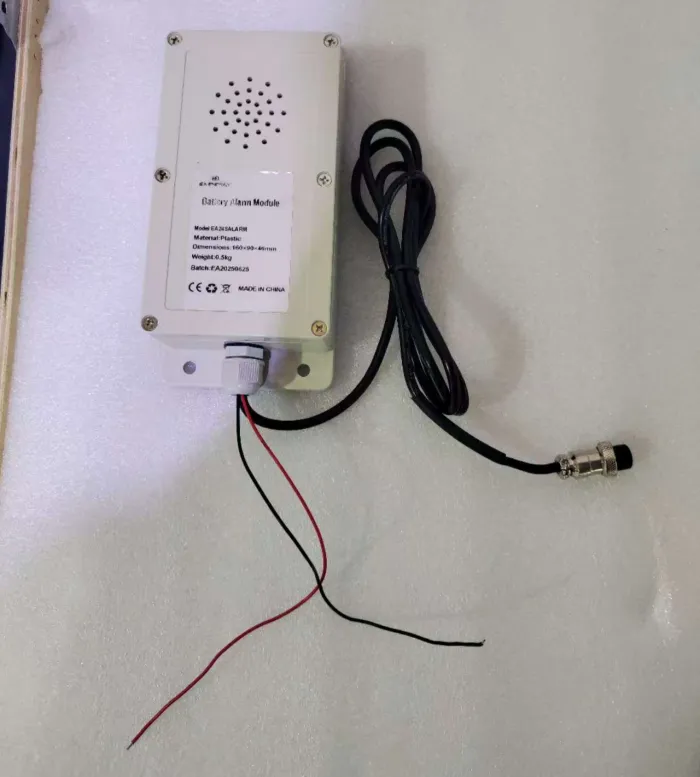
The EA24230S addresses both with a low-voltage alarm system with lift-motor lockout. Here's how it works:
1. When pack voltage drops toward a configurable threshold — for example, 24V — the system sounds an alarm, warning the operator that the battery needs charging.
2. If voltage falls below the threshold, the system locks out the lift (ascending) motor, preventing further upward movement while preserving enough reserve energy for descent and drive functions.
3. The battery is protected from deep-discharge damage — and the operator is never stranded at height by a battery pushed past its safe limit.
It's a simple feature with a double payoff: a critical safety layer for the person in the platform, and a hardware guarantee that no customer can accidentally destroy the battery by running it to zero. For a rental fleet, that second point alone saves real money every single week.
Factor | OEM Lead-Acid (4 × 6V 225Ah) | EA24230S LiFePO4 |
Usable Energy per Charge | ~2.7–3.2 kWh (50–60% DoD) | ~5.6 kWh (95% DoD) |
Typical Runtime | Partial shift (degraded fleet) | Full working day |
Charge Time | 8–10 hours | Opportunity-charge capable |
Routine Maintenance | Watering, equalization, terminal cleaning | None |
Cycle Life | 1,000–1,500 cycles | 4,000+ cycles |
Peak Power Delivery | Voltage sag under load | 300A BMS, stable voltage to 270A peaks |
Deep-Discharge Protection | None (sulfation damage) | Low-voltage alarm + lift lockout |
Fleet Visibility | None | Real-time GPS, 4G data, geofencing |
Replacements Over 8 Years | 2–3 sets | 1 pack |
For rental equipment specifically, the math compounds: fewer service calls, fewer battery-related customer complaints, higher machine uptime, longer billing days per machine, and dramatically lower replacement frequency. Most fleets in this duty profile see lithium conversions pay back within 18 to 24 months — and the telematics data keeps delivering value long after.
This project highlights why rental companies have become the fastest adopters of lithium power for aerial platforms:
1. Uptime is inventory. A machine that can't lift can't be billed. Doubling usable energy per charge directly increases rentable days.
2. Abuse is the default. Rental customers don't maintain batteries. Lithium eliminates watering and tolerates imperfect charging habits — and the lockout feature physically prevents deep-discharge abuse.
3. Visibility is control. GPS, geofencing, and live battery data turn a scattered fleet into a managed asset base — with theft deterrence built in.
4. Small machines, big fleets. A single standard pack like the EA24230S can serve an entire GR-series fleet (GR-12, GR-15, GR-20 share the same 24V architecture), simplifying inventory across dozens or hundreds of machines.
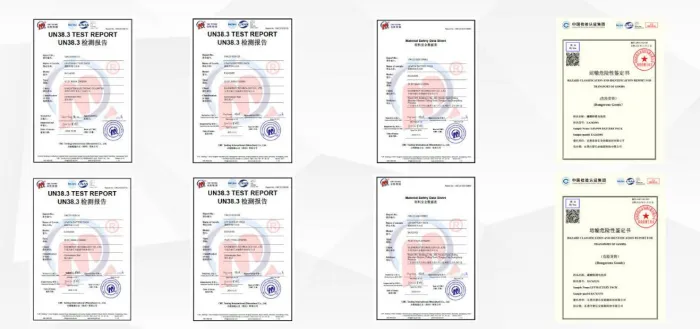
Every EA24230S ships with a complete compliance package: UN38.3 test report, MSDS, transport hazard assessments for sea, road, and air, and CE/UL certifications for European and North American markets. For this U.S. deployment, documentation and shipping cleared without friction — the same readiness we bring to every market.
A fleet of Genie GR-20 lifts that couldn't make it through a morning now works full days on a single charge. A battery compartment measuring 20 × 14 × 12 inches now holds 5.9 kWh of LiFePO4 energy instead of a dying bank of lead-acid. A 300A BMS delivers the machine's full 270A peak without breaking a sweat. GPS and geofencing put every machine on the map, and a low-voltage lockout protects both the operator at height and the battery investment below.
That's what the EA ENERGY EA24230S delivered for this U.S. rental fleet — and it's what it can deliver for yours.
If your aerial work platforms are held back by aging lead-acid batteries, short runtimes, and zero fleet visibility, contact the EA Battery team today. Send us your battery compartment dimensions and machine model — we'll engineer the maximum-capacity lithium solution for your fleet.
Q: Does the EA24230S fit the Genie GR-20 without modifications?
A: Yes. The pack measures 495 × 297 × 200 mm, precision-engineered for the GR-20's OEM battery compartment (20" × 14" × 12"). It's a true drop-in replacement for the original four 6V 225Ah lead-acid batteries — no machine modifications required. The complete assembly is ballasted to meet Genie's battery weight requirement, since GR-series machines use the batteries as counterweight.
Q: How much more runtime will a GR-20 get with the EA24230S?
A: The pack stores approximately 5.9 kWh and delivers about 5.6 kWh of usable energy at 95% depth of discharge — nearly double the usable energy of even brand-new OEM lead-acid batteries (which must be managed at 50–60% DoD). Compared to aged lead-acid packs, the improvement is several-fold: machines that died mid-shift now work full days.
Q: Can the battery handle the GR-20's peak power demands?
A: Absolutely. The GR-20 draws 80–170A in typical operation, peaking around 270A at maximum demand. The EA24230S uses a 300A continuous-discharge smart BMS, providing comfortable headroom above the machine's peak — no voltage sag, no nuisance BMS trips, full machine performance at any state of charge.
Q: How does the low-voltage lockout work, and why does it matter?
A: When battery voltage drops toward a configurable threshold (e.g., 24V), an alarm warns the operator to finish the task and charge. Below the threshold, the system locks out the lift motor to prevent further discharge while preserving reserve power for descent and drive. This protects the operator from being stranded at height and protects the battery from deep-discharge damage — a critical feature for rental duty.
Q: What can I see with the GPS 4G monitoring system?
A: Real-time state of charge, state of health, voltage, temperature, and live discharge current for every machine; GPS location tracking for the entire fleet; and configurable geofences with instant alerts when a machine leaves its designated area. It's designed specifically for rental fleet asset control, theft deterrence, and usage verification.
Q: Is the same battery available for other Genie models?
A: Yes. The GR-12, GR-15, and GR-20 share the same 24V system architecture, and we engineer custom-fit packs for scissor lifts, boom lifts, and mast lifts across all major brands — Genie, JLG, Skyjack, Haulotte, and more. Send us your machine model and battery compartment dimensions for a tailored solution.
Q: What certifications does the battery carry?
A: Every unit ships with a full documentation package including the UN38.3 test report, MSDS, transport hazard assessments, and CE/UL certifications for European and North American markets.
This is the first one.
 English
  Lithium Golf Cart Battery
  Low Speed Vehicle Battery
  Lithium Forklift Battery
  Aerial Work Platform Battery
  Floor Cleaning Machine Battery
  Lithium Marine Battery
  Residential ESS
  Commercial & Industrial ESS
  Truck Electrical System
  RV Electrical System