The global transition to lithium-ion technology has triggered a “Gold Rush” in the battery manufacturing sector. For international distributors and procurement managers, the market is now flooded with thousands of suppliers claiming to offer “High-Quality LiFePO4.”
However, in the industrial sector—where batteries power million-dollar forklift fleets and mission-critical AGVs—the cost of a “bad batch” is catastrophic. A single cell failure can lead to equipment downtime, expensive recalls, and, in worst-case scenarios, significant liability risks. Choosing a battery partner is no longer just about the lowest price per kilowatt-hour ($/kWh). It is about Engineering Integrity, Supply Chain Transparency, and Long-term Reliability. This guide outlines the five critical technical and operational criteria for evaluating a LiFePO4 manufacturer in today’s competitive landscape.
Every supplier claims to use “Grade A” cells. To a sourcing agent, this term often feels like marketing jargon. In the EA BATTERY engineering lab, however, “Grade A” has a very specific technical definition based on Cell Consistency.
Internal Resistance (IR) Variance: In a high-quality industrial pack, the IR of individual cells should vary by no more than ±0.2mΩ to ±0.5mΩ. High variance leads to uneven heating and premature pack failure.
Capacity Matching: Cells must be matched within ±1% of their rated capacity. If a 100Ah pack contains one cell that is actually 95Ah, the entire pack’s usable capacity is limited to 95Ah.
Voltage Deviation: After 72 hours of “rest,” the voltage difference between cells in a batch should be less than 5mV.
The EA BATTERY Advantage: We perform 100% automated cell sorting and matching before assembly. We provide our distributors with Cell Test Reports that document the IR and voltage of every cell in their specific shipment.
Many “manufacturers” are actually assembly shops that buy generic Battery Management Systems (BMS) from third-party vendors. For light-duty consumer electronics, this is acceptable. For industrial use, it is a major risk.
Thermal Management Logic: Does the BMS have the logic to throttle current when temperatures rise, or does it simply shut down?
Communication Protocols: Can the manufacturer customize the CAN-bus or RS485 protocol to match your specific forklift or inverter? A generic BMS usually lacks the firmware flexibility required for deep integration.
Protection Layers: Look for a BMS that offers Redundant Hardware Protection. This means if the software fails, a physical fuse or secondary circuit will still prevent an over-charge event.
The EA BATTERY Advantage: As a global leading motive power batteries supplier, our BMS is engineered in-house. This allows us to offer Custom Firmware Updates for our distributors, ensuring our batteries are compatible with the latest AGV and Forklift models from Toyota, Yale, Linde, and others.
Industrial lithium batteries are highly sensitive to contamination. A single microscopic dust particle or metal shaving introduced during assembly can cause a “micro-short,” which might not lead to failure until 6 months of use.
Dust-Free Assembly Environment: Are the cell-balancing and laser-welding areas climate-controlled and dust-filtered?
Laser Welding Technology: High-vibration industrial applications (like forklifts) require laser welding for busbars. “Bolt-on” or “Spot-welded” connections are prone to loosening under mechanical stress.
End-of-Line (EOL) Testing: Does the manufacturer perform a Full Charge/Discharge Cycle Test on the finished pack before shipping? Many factories only test for “voltage presence” to save time.
The EA BATTERY Advantage: Every EA BATTERY pack undergoes a 24-hour EOL Stress Test. This includes a vibration test and a full-capacity discharge to ensure the BMS and cells are perfectly synchronized.
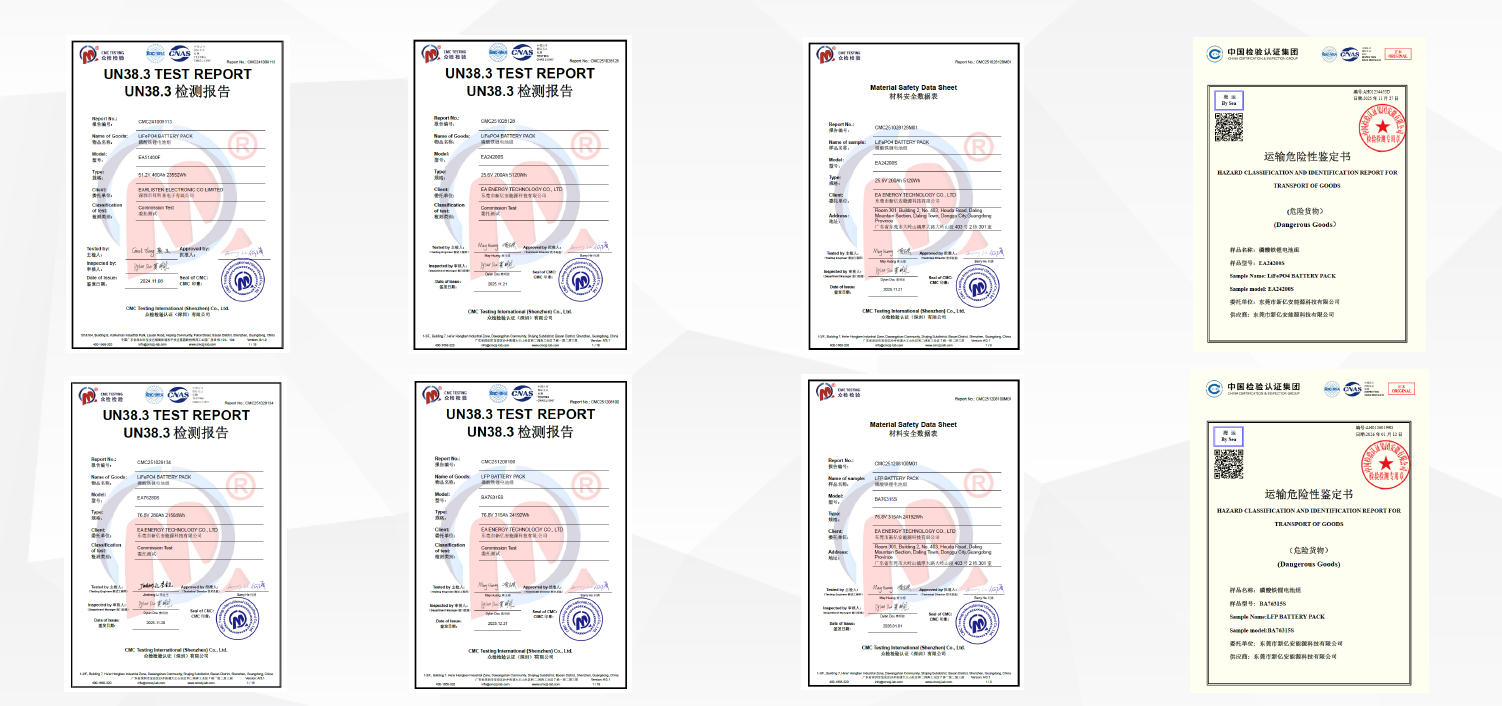
For a distributor, the lack of proper certification is a legal and logistical nightmare. Customs officials in the EU and North America are increasingly strict regarding lithium battery imports.
UN38.3: This is the global standard for the Safe Transport of Lithium Batteries. Without it, your goods cannot be shipped by air or sea legally.
MSDS (Material Safety Data Sheet): Required for all logistics and insurance documentation.
CE-EMC & LVD: Critical for the European market to ensure the battery meets safety and electromagnetic compatibility standards.
UL2580 (Optional but Recommended): Specifically for electric vehicle and industrial battery safety in North America.
The EA BATTERY Advantage: We maintain an up-to-date Certification Library. When you partner with us, we provide the full documentation package required for your local customs clearance and insurance providers.
The true value of a manufacturer is revealed after the wire transfer is complete. B2B buyers should be wary of suppliers who do not offer a clear technical support path.
What is the “Real-World” Warranty? Does the warranty cover the full cycle life (e.g., 3,500 cycles) or just a calendar period?
How are Repairs Handled? Do you provide spare parts (BMS boards, fuses, connectors) or do you require the entire 150kg battery to be shipped back to China?
Is Remote Diagnostics Available? Can your team analyze a battery’s data log remotely via a Bluetooth or IoT interface?
The EA BATTERY Advantage: We offer a Modular Repair System. In the rare event of a BMS failure, our boards are designed to be easily swappable by your local technicians. We provide video training and a dedicated WhatsApp/WeChat technical support line for our authorized distributors.
To help procurement officers visualize the risk, we have compiled a “Risk-Cost” comparison:
| Metric | Low-Cost “White Label” Supplier | EA BATTERY (Partner Grade) |
|---|---|---|
| Cell Origin | Unverified / B-Grade / Second-life | Brand New, Grade A, Matched |
| BMS Type | Generic / No Communication | Proprietary / Smart CAN-bus |
| Cycle Life | 1,000 - 1,500 | 3,500 - 5,000+ |
| Customization | None (Take what is in stock) | Full OEM/ODM Flexibility |
| Failure Rate | 3% - 5% (High RMA Costs) | <0.2% (Industrial Reliability) |
The industrial battery market is not a retail environment; it is a relationship-driven industry. A distributor’s reputation is only as good as the last battery they sold. By choosing a manufacturer that prioritizes Technical Precision, Safety Certifications, and After-Sales Transparency, you are not just buying a product—you are securing your business’s future in the electrification era. At EA BATTERY, we invite you to look past the marketing slogans. Ask us for our test reports, tour our facility via video link, and speak with our engineers. We don’t just want to be your supplier; we want to be the technical foundation of your success.
 English
  Lithium Golf Cart Battery
  Low Speed Vehicle Battery
  Lithium Forklift Battery
  Aerial Work Platform Battery
  Floor Cleaning Machine Battery
  Lithium Marine Battery
  Residential ESS
  Commercial & Industrial ESS
  Truck Electrical System
  RV Electrical System