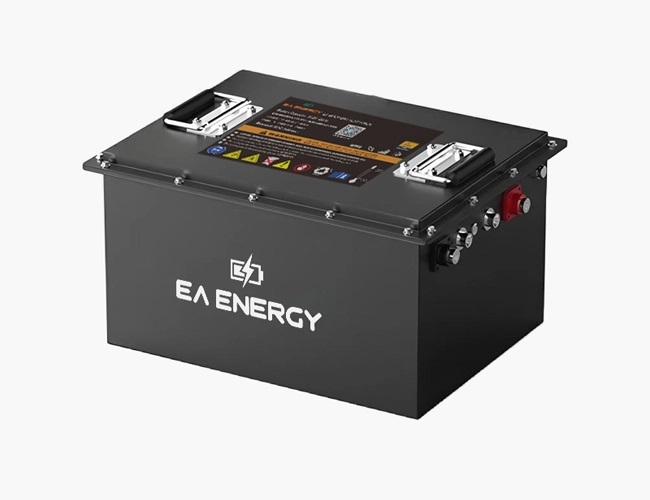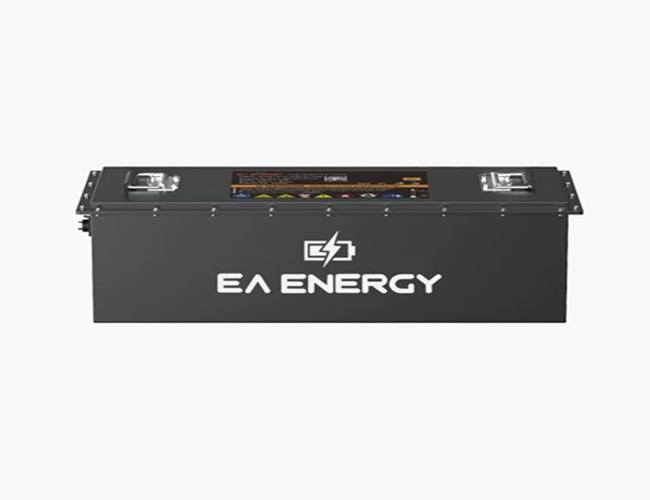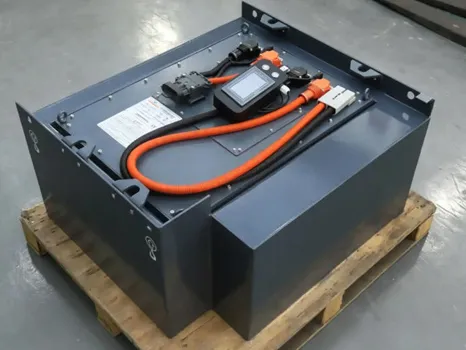
In the world of industrial energy storage, the Lithium Iron Phosphate (LiFePO4) cell is often celebrated as the “brawn”—the raw chemical force that provides energy. However, without a sophisticated “brain” to manage that force, even the highest-quality cells are prone to inefficiency, premature degradation, and safety risks.
That brain is the Battery Management System (BMS). For industrial applications—ranging from heavy-duty forklifts and AGVs to commercial energy storage—the BMS is the single most critical component in determining the system’s lifespan and reliability. In this technical deep dive, we explore how EA BATTERY’s proprietary BMS architecture elevates LiFePO4 technology from a simple battery pack to an intelligent, industrial-grade power solution.
Unlike lead-acid batteries, which are relatively “forgiving” regarding overcharging and voltage fluctuations, lithium-ion chemistries require precise operating windows. A LiFePO4 cell typically operates between 2.5V (fully discharged) and 3.65V (fully charged). If a cell exceeds 3.9V, the electrolyte can decompose, leading to permanent damage. Conversely, if it drops below 2.0V, copper shunts can form, creating internal short circuits. In a multi-cell industrial pack (such as an 80V forklift battery containing 25 cells in series), a single “out-of-sync” cell can jeopardize the entire system. The BMS acts as the “Guardian,” ensuring every individual cell operates within its Safe Operating Area (SOA).
One of the most debated topics in battery engineering is cell balancing. As a battery ages, individual cells develop slight variances in internal resistance and capacity. Without balancing, the weakest cell will reach the “empty” mark first, forcing the entire pack to shut down despite having remaining energy in other cells.
Most budget manufacturers use passive balancing. When a cell reaches full charge, the BMS dissipates the excess energy as heat through a resistor.
Limitation: It only works at the very end of the charge cycle and typically handles low currents (30mA to 100mA). In a 500Ah industrial pack, 50mA of balancing current is practically negligible.
EA BATTERY’s high-performance packs utilize Active Balancing technology. Instead of wasting excess energy as heat, the BMS “transfers” charge from the highest-voltage cells to the lowest-voltage cells dynamically.
Technical Data: Our active balancers support currents up to 2.0A to 5.0A.
The Result: By redistributing energy during both the charge and discharge phases, we can extend the usable capacity of an aging pack by 12% to 15% and increase the total cycle life by up to 20%.
For a logistics manager, there is nothing more frustrating than a “Ghost Discharge”—a battery that shows 20% charge but suddenly cuts out. EA BATTERY utilizes a multi-layered algorithm to provide industry-leading accuracy in reporting:
Coulomb Counting: Measuring the actual current (Amps) entering and leaving the battery over time.
Open Circuit Voltage (OCV) Mapping: Comparing voltage levels during rest periods to a chemical-specific lookup table.
Dynamic Impedance Tracking: Measuring voltage drops under specific loads to estimate the internal resistance.
By combining these methods, our BMS provides State of Charge (SOC) accuracy within ±3%. Furthermore, our State of Health (SOH) monitoring tracks the battery’s degradation over years, allowing for predictive maintenance before a failure occurs.
Safety is the cornerstone of EA BATTERY’s engineering philosophy. Our BMS employs a three-tier protection architecture:
The BMS uses ultra-fast MOSFETs or high-voltage contactors to disconnect the circuit in microseconds if it detects:
Short Circuits: Detection speeds under 200µs.
Over-Current: Protection against surges during motor startup in heavy machinery.
The firmware monitors environmental variables and triggers “Soft Limits.” For example, if the battery temperature reaches 55°C (131°F), the BMS will not shut down the forklift (which could be dangerous in the middle of a task) but will instead “throttle” the maximum current to allow the system to cool down.
Industrial batteries often work in cold storage environments (-30°C). Since LiFePO4 cannot be safely charged below 0°C, the EA BATTERY BMS manages integrated heating films. When a charger is connected, the BMS first uses the input power to warm the cells to 10°C before allowing the charging current to flow, ensuring zero chemical damage.
In the age of Industry 4.0, a battery cannot be an “island.” It must communicate with the vehicle (Forklift/AGV) and the facility's management system.
CAN-bus 2.0B Support: Our BMS is compatible with the communication protocols of major Tier 1 brands (such as Toyota, Linde, Jungheinrich, and Hyster-Yale). It shares real-time data on voltage, current, temperature, and error codes.
Bluetooth & Mobile App: For smaller fleets or individual users (Golf Carts/RV), we provide a mobile interface. Technicians can perform a “Health Check” without even opening the battery casing.
Cloud Telematics (IoT): For large-scale deployments, EA BATTERY offers a gateway that uploads data to a secure cloud. Fleet managers can view the GPS location, charging history, and “abusive events” (e.g., leaving a battery discharged for weeks) from any computer in the world.
To ensure our BMS meets the rigors of international trade and safety, EA BATTERY adheres to the following standards:
UL 2580: Safety for batteries in electric vehicles.
IEC 62619: Safety requirements for large-format industrial lithium batteries.
CE-EMC: Ensuring our BMS logic does not interfere with other electronic systems in the warehouse.
UN38.3: Stringent vibration, shock, and thermal testing for safe global transport.
Choosing a LiFePO4 supplier is often seen as a choice of cells. However, experienced engineers know that while cells provide the energy, it is the BMS that provides the value. A poorly designed BMS will lead to unbalanced cells, inaccurate SOC readings, and potentially dangerous thermal events. An EA BATTERY BMS provides the intelligence required to maximize ROI, ensure operator safety, and provide the seamless data integration required for modern automated logistics. At EA BATTERY, we don’t just assemble batteries; we engineer intelligent power systems as a professional motive power batteries supplier. Whether you are an OEM designing the next generation of AGVs or a warehouse manager upgrading your forklift fleet, our technical team is ready to help you integrate the “smartest” battery on the market.
 English
  Lithium Golf Cart Battery
  Low Speed Vehicle Battery
  Lithium Forklift Battery
  Aerial Work Platform Battery
  Floor Cleaning Machine Battery
  Lithium Marine Battery
  Residential ESS
  Commercial & Industrial ESS
  Truck Electrical System
  RV Electrical System