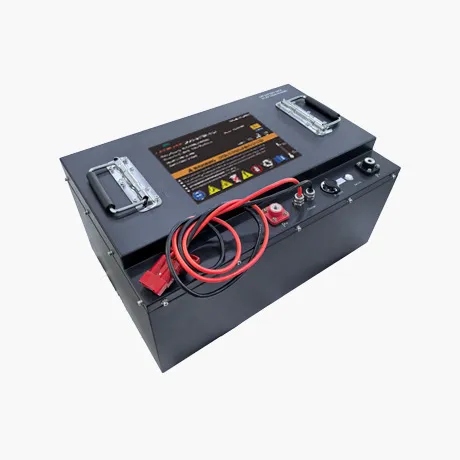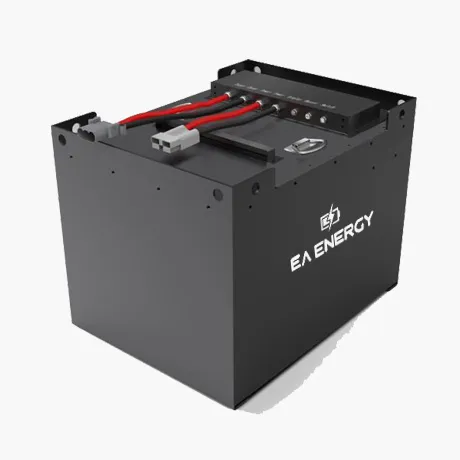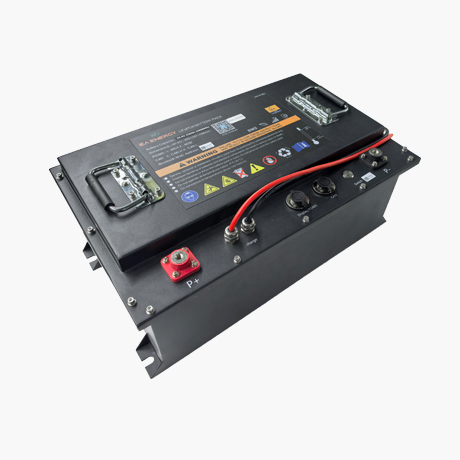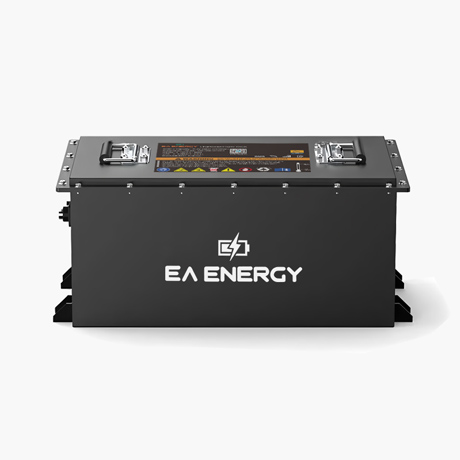
For commercial transport managers and owner-operators, maintaining a profitable fleet requires balancing tight margins against rising operational costs. While engine performance and aerodynamics get plenty of attention, the standard commercial vehicle battery setup remains a hidden source of unexpected maintenance and unnecessary fuel burn.
Traditional lead-acid and Absorbed Glass Mat (AGM) batteries have served heavy-duty transport for decades, but they struggle to keep pace with the power demands of modern logistics. Upgrading to an advanced lithium truck battery allows fleet operations to lower total cost of ownership (TCO) while enhancing on-the-road efficiency.
The primary limitation of traditional lead-acid systems is their usable capacity and lifespan. A standard lead-acid or AGM commercial battery can typically only be discharged down to 50% of its total capacity without causing permanent internal damage and accelerating cell failure. In contrast, a lithium ion truck battery safely allows for an 80% to 90% depth of discharge (DoD).
This functional difference means a single lithium-based power source delivers far more usable energy than a significantly heavier lead-acid counterpart. For global business-to-business (B2B) procurement structures, switching to this chemistry streamlines operations by providing a reliable energy delivery system that standardizes performance across regional routes.
Driver turnover and anti-idling regulations present persistent challenges for logistics managers. Heavy-duty diesel truck engines consume approximately 0.5 to 1.0 gallon of fuel per hour while idling. With modern anti-idling regulations enforcing strict limits, fleets require an alternative method to keep drivers comfortable during mandatory rest periods.
Integrating a high-capacity lithium ion truck battery allows vehicles to run auxiliary hotel loads, sleeper-berth appliances, and parking climate control units for more than 20 hours on a single charge. By powering these systems entirely from an auxiliary battery bank instead of the primary diesel engine, fleet operators eliminate compliance risks and directly lower fuel expenditures.
Commercial trucks demand two distinct types of electrical performance: massive, immediate cold cranking amps (CCA) to turn over heavy-duty diesel engines, and steady, low-amperage deep-cycle power to run electronics when the alternator is off. Traditionally, fleets had to separate these tasks or rely on massive, multi-battery lead-acid banks that degraded quickly under mixed usage.
Modern dual-purpose lithium options solve this by delivering up to 2,500A of reliable engine-starting current alongside deep-cycle capacity. Because lithium maintains a stable voltage curve above 13V throughout its discharge cycle, on-board telematics, liftgates, and safety sensors receive clean, consistent power without the voltage sags that cause system errors in older setups.
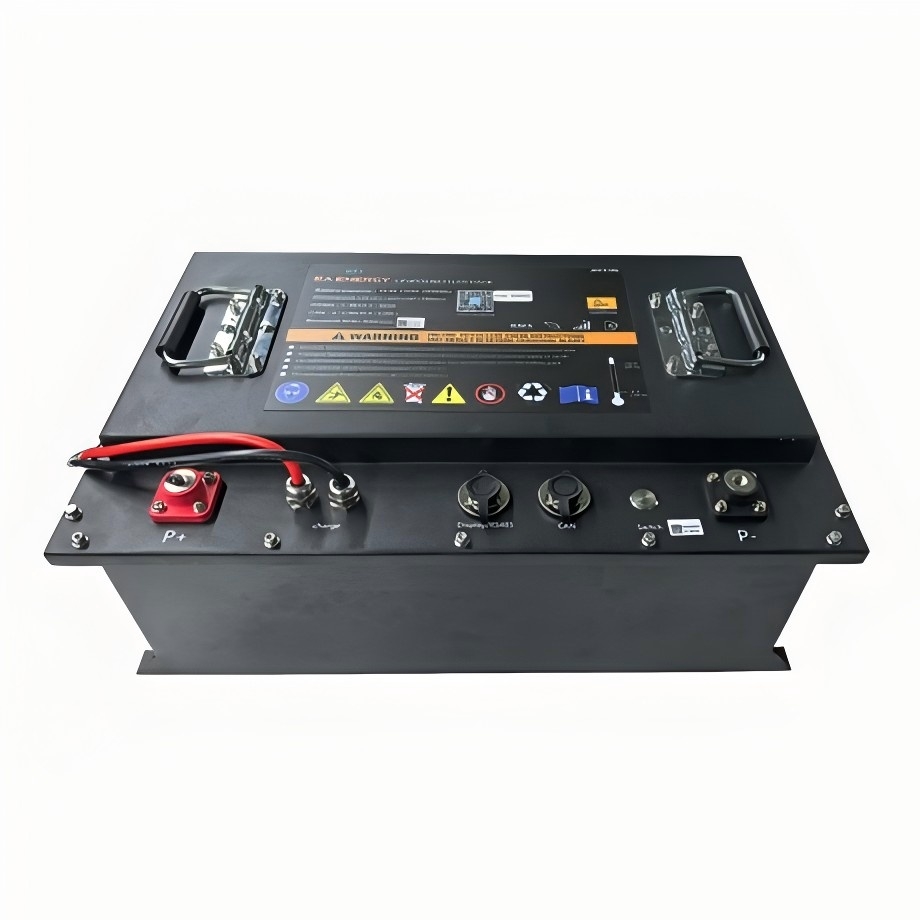
While the upfront cost of a lithium truck battery is higher than a standard flooded or AGM unit, the long-term return on investment (ROI) changes the equation for procurement managers. A standard heavy-duty lead-acid battery typically delivers between 300 and 500 charge cycles before its capacity degrades below operational limits, requiring replacement every 12 to 24 months.
Lithium iron phosphate (LiFePO4) commercial batteries regularly achieve 3,000 to 5,000 cycles at an 80% depth of discharge. Spreading the initial investment over a lifespan that matches or exceeds the service life of the truck reduces battery replacement and associated labor costs by up to 80%.
Operational Metric | Standard AGM Battery | Advanced Lithium-Ion Battery |
Usable Capacity (DoD) | 50% max discharge | 80% – 90% safe discharge |
Expected Lifespan | 300 – 500 cycles (1–2 years) | 3,000 – 5,000 cycles (8–10 years) |
Average Unit Weight | 60 – 70 lbs per unit | 25 – 35 lbs per unit |
Charge Efficiency | 75% – 85% (energy lost as heat) | 95%+ (faster, cooler charging) |
Maintenance Required | Periodic terminal cleaning / testing | None (zero maintenance) |
Sudden battery failure is a primary cause of unscheduled fleet downtime, resulting in delayed deliveries, disrupted supply chains, and costly emergency roadside service calls. A lithium ion truck battery prevents these unexpected failures by integrating an intelligent, internal Battery Management System (BMS).
The BMS acts as an automated digital technician inside the casing. It constantly tracks cell temperatures, balances voltages, and guards against common issues like short circuits or over-discharging. For winter operations, advanced lithium setups include integrated thermal heating elements. When the system detects sub-freezing temperatures during a charge cycle, it uses incoming alternator or solar current to warm the internal cells to a safe temperature before allowing energy intake, ensuring consistent all-weather start-up reliability.
A common concern among fleet maintenance directors is the complexity of upgrading existing electrical architecture. Modern commercial lithium batteries are engineered to match standard B2B industry form factors, such as Group 31 casings, enabling direct drop-in replacement into standard truck battery trays without structural modifications.
Furthermore, these systems are entirely sealed and maintenance-free. They eliminate the labor hours spent checking water levels, cleaning acid corrosion from brackets, or replacing cables damaged by off-gassing. For logistics firms looking to balance their carbon footprint, selecting long-lasting battery systems aligns with corporate sustainability initiatives by significantly reducing the volume of lead and plastic waste entering recycling streams each year.
Upgrading a fleet to premium lithium truck battery is a strategic operational choice that directly impacts a transport company's bottom line. By resolving the core issues of short battery lifespans, frequent roadside service calls, and high fuel use from engine idling, lithium power systems deliver a reliable, long-term foundation for modern commercial shipping. When evaluating fleet modernization strategies, integrating advanced components like those offered by EA ENERGY ensures your trucks remain compliant with environmental regulations while maximizing over-the-road productivity.
Yes. Built with stable Lithium Iron Phosphate (LiFePO4) chemistry and secured inside reinforced casing, these batteries handle intense commercial road shock without the risk of internal plate shedding or thermal runaway common in lead-acid options.
Lithium-ion systems boast 95%+ charge efficiency. While an AGM battery takes 6 to 8 hours to safely absorb a full charge, a lithium truck battery can accept high current directly from the alternator and recharge from 20% to 100% in 1 to 2 hours of drive time.
No. Because they operate on entirely different voltages, internal resistances, and charging profiles, mixing them in the same circuit will cause severe charging imbalances, rapidly damaging the lead-acid units and triggering safety cut-offs.
Lithium maintains a steady voltage output in freezing conditions, outperforming lead-acid cranking power. To prevent damage when charging in the cold, commercial units include internal heating elements that automatically warm the cells before accepting power.
None. Premium commercial lithium batteries use standard industry form factors (like Group 31 casings) to fit existing battery boxes and connect to standard cables. You only need to verify your alternator outputs a standard modern voltage profile.
Lithium lasts up to 10 times longer, cutting out multiple replacement purchases and workshop labor hours. When paired with massive diesel savings by running parking air conditioning without idling the engine, the upgrade typically pays for itself within 12 to 18 months.
 English
  Lithium Golf Cart Battery
  Low Speed Vehicle Battery
  Lithium Forklift Battery
  Aerial Work Platform Battery
  Floor Cleaning Machine Battery
  Lithium Marine Battery
  Residential ESS
  Commercial & Industrial ESS
  Truck Electrical System
  RV Electrical System