EZGO golf carts serve as core vehicles for golf course operations, scenic area shuttles, and community transportation, and have long relied on lead-acid batteries for power. In high-load operation scenarios such as 18-hole standard golf courses, mountain resorts, and large cultural tourism parks, the regular water topping-up, long charging cycles, frame corrosion from acid mist, and sharp capacity drop at low temperatures of traditional lead-acid batteries are continuously driving up operating costs and reducing vehicle turnover efficiency. EA ENERGY has launched the EA51120S lithium iron phosphate (LFP) battery pack solution for the full EZGO model lineup — this is not a simple capacity replacement, but an OEM-grade powertrain upgrade solution that deeply matches the original battery compartment structure, on-board electrical protocols, and overall vehicle weight distribution.
This solution is backed by EA ENERGY’s long-term technical expertise in LFP battery pack assembly and industrial vehicle batteries, as well as accumulated data from long-term supporting supply for mainstream golf cart models worldwide. Below is a comprehensive breakdown of how this EZGO-specific lithium battery assembly integrates seamlessly into daily operations, covering global delivery compliance, operating condition adaptation, cell topology, BMS technology, manufacturing quality control, on-site installation, energy efficiency comparison, global service network, OEM supporting capabilities, operation and maintenance ecosystem, and dual-technology route value.
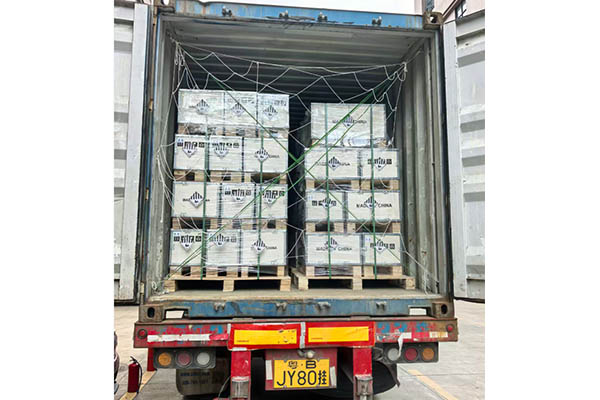
Lithium-ion batteries are classified as Class 9 dangerous goods, and the cross-border delivery compliance document system is a core consideration for overseas customers when selecting suppliers. EA ENERGY has standardized three core documents: dangerous goods classification appraisal report, use appraisal result sheet for export dangerous goods transport packaging, and transport condition appraisal certificate. Each batch of goods is assigned a dedicated container number and seal, and booked by freight forwarders with dangerous goods declaration qualifications, enabling shipment from major Chinese ports to core port areas worldwide. For urgent orders, the product has obtained authoritative air transport appraisal qualifications, and can be delivered via dedicated freighter lines for global urgent orders.
In terms of packaging, each battery unit is packed in a UN-standard plywood box with built-in buffer layers and short-circuit protection covers. Class 9 dangerous goods labels and lithium battery operation warning labels are affixed to the exterior of the box in compliance with regulations. For full container loading, dedicated anti-tipping brackets are used for fixation, and fire emergency equipment and emergency handling guidelines are provided with the shipment. This standardized storage and transportation process has passed multiple rounds of compliance inspections by major global ports, shipping companies, and European and American destination ports, ensuring smooth customs clearance and stable delivery lead times for customers in golf-intensive regions such as North America, Europe, and Southeast Asia.
Mainstream EZGO models including TXT, RXV, and Express S2/S4 are widely used in golf courses, hotel shuttles, and scenic area sightseeing. They operate in diverse environments including flat cruising, sloped terrain, outdoor sun exposure, and rain, placing strict requirements on battery compartment installation dimensions, overall vehicle center of gravity, waterproof rating, and high/low temperature performance. The original lead-acid batteries for these models are mostly 6V/8V units connected in series to form a 48V system, with rated capacity ranging from 150Ah to 250Ah, total pack weight mostly between 280kg and 380kg, and overall dimensions around 990mm × 420mm × 300mm.
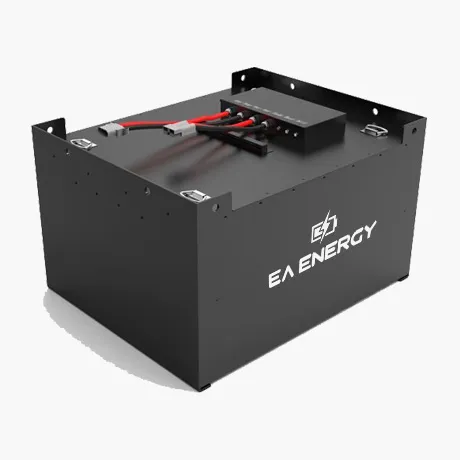
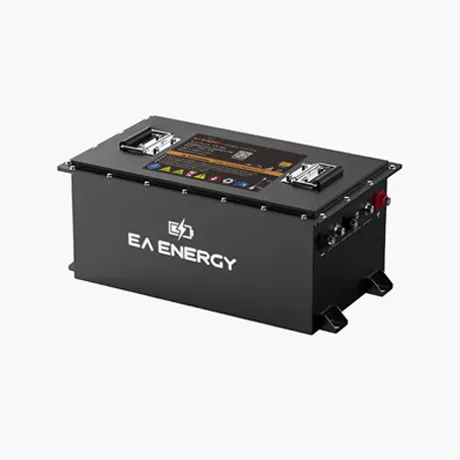
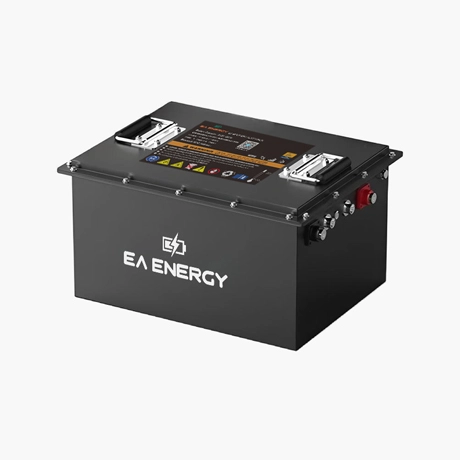
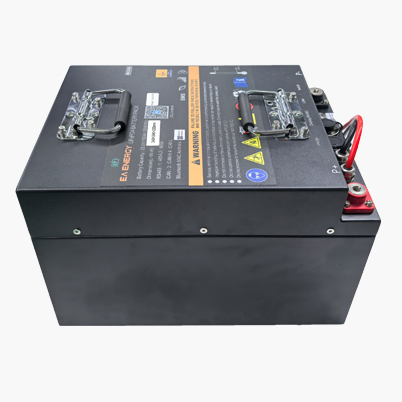
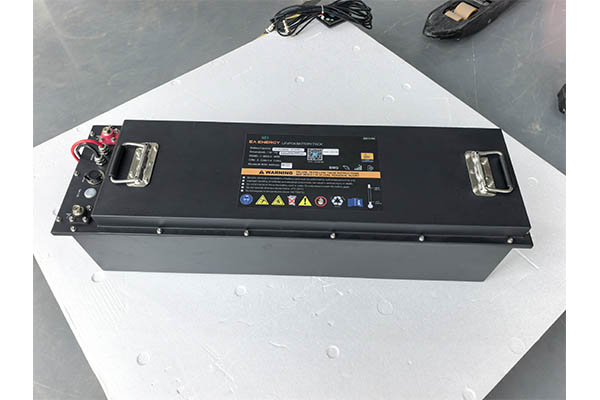
The EA ENERGY EA51120S achieves precise adaptation with electrical parameters of 51.2V/120Ah. The battery pack has external dimensions of 830mm × 253mm × 225mm and a total weight of 65kg, delivering a perfect drop-in fit for the original battery compartment. The fixing holes and connector positions fully correspond to the original vehicle design, and the bottom support structure and upper pressure plate mechanism can all directly use the original design, eliminating the need for structural modifications such as cutting or drilling the battery compartment. Compared with the original lead-acid solution, the battery weight is reduced by approximately 215kg to 315kg, but the front and rear axle loads of the vehicle always remain within EZGO’s original design thresholds — EA ENERGY optimized the cell arrangement density for the weight balance logic of golf carts during the PACK design stage, ensuring hill-climbing stability and high-speed driving smoothness are not affected through housing strength and internal structure optimization.
In terms of voltage platform, conventional 48V lead-acid systems have a full charge voltage of approximately 57.6V, with the discharge platform maintained at around 48V. The EA51120S adopts a 16-series LFP architecture, with a full charge voltage of 58.4V, a rated discharge platform of 51.2V, and a mid-discharge voltage stabilized between 50.4V and 51.2V, which naturally matches the voltage operating windows of the EZGO’s motor controller, on-board instrument, and lighting system. The battery low-voltage protection threshold is set at 40V (2.5V per cell), which exactly covers the original vehicle’s undervoltage alarm trigger range. This electrical replacement solution does not require additional DC/DC conversion modules or modification of the original vehicle wiring harness and connectors, and is a direct physical-layer replacement.
In terms of model nomenclature, EA stands for the brand, 51 represents the nominal voltage class, 120 corresponds to the rated capacity, and S refers to the standard adaptation model, adopting a 16-series 1-parallel grouping architecture. The 120Ah single-cell capacity configuration adopts a large-capacity prismatic aluminum-shell energy storage cell route, with a total energy of 6.144kWh after grouping. Under typical EZGO golf course operating conditions, a fully charged pack can support 27 consecutive holes of play or 50 to 70 kilometers of cruising; a 30-minute charge during the lunch break can cover the operational demand of the second half of the day.
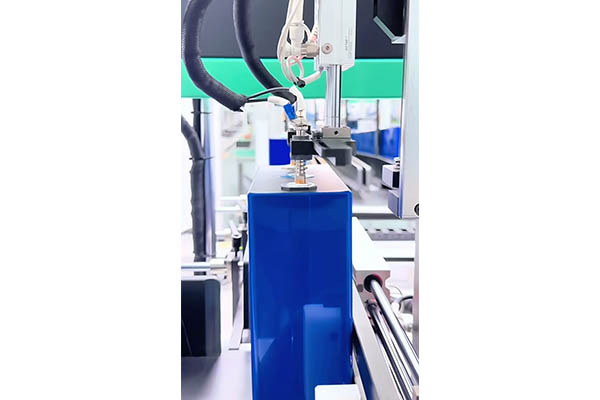
All cells are automotive-grade A-grade cells, with the supply chain directly connected to first-tier manufacturers such as CATL, EVE Energy, CALB, and Lishen Battery. Cells have completed full screening of OCV, internal resistance, and K-value self-discharge before leaving the factory. After incoming inspection, EA ENERGY adds a secondary capacity grading and grouping process, controlling the inter-series voltage difference within 5mV and internal resistance deviation within 0.1mΩ, fundamentally avoiding the "wooden barrel short board" in the series circuit. The 16-series modules are connected by aluminum busbar laser welding, and the weld penetration consistency is fully inspected online by machine vision systems, completely eliminating the hidden danger of heat caused by false welding.
The entire module is wrapped in a flame-retardant insulating housing, with positive and negative electrodes led out by copper-aluminum composite busbars, and connected to the BMS main board via acquisition wiring harnesses. The battery shell adopts cold-rolled steel plate plastic spraying process, with an overall protection rating of IP65, which can withstand outdoor rain, sprinkler cleaning, and humid environments. Forklift operation holes and anti-slip buffer pads are reserved at the bottom of the battery to adapt to workshop disassembly and assembly operations. For customers operating in northern winter golf courses and high-altitude low-temperature scenic areas, built-in silicone heating films and insulation layers are optional, which can preheat the cells to 5℃ before enabling charging in -20℃ environments; for summer high-temperature sun exposure scenarios, a built-in heat dissipation air duct and temperature control strategy prevent cell overheating and degradation.
EA ENERGY’s self-developed BMS (Battery Management System) unit is embedded in the waterproof maintenance compartment on the side of the battery pack. The external interfaces include original vehicle-specific plugs, communication ports, and charger interlock signal lines.
The system can monitor individual cell voltage, total voltage, charge-discharge current, and multi-point temperature in real time. The SOC estimation adopts a hybrid algorithm of ampere-hour integration combined with open-circuit voltage correction, and the estimation accuracy can be controlled within 5%. The equalization function adopts a passive equalization scheme, which discharges the series positions with excessive voltage difference at the end of charging, with an equalization current of about 200mA, which can maintain the consistency of the battery throughout its life cycle.
For the EZGO’s vehicle electrical architecture, the BMS can output a stepped voltage signal matching the lead-acid meter, allowing the original vehicle battery indicator to light up normally according to the original segmented logic; it can also send SOC messages to high-end models via CAN bus, displaying percentage power on the on-board display.
During charging, the BMS communicates and handshakes with the EA ENERGY matched AC220V/DC58.4V 30A smart charger, and executes a three-stage charging curve: constant current - constant voltage - float charge. The total charge cut-off voltage of the 16-series system is 58.4V, corresponding to 3.65V per cell. After entering the constant voltage stage, the current gradually decays to below 1A and then shuts down automatically, avoiding the risks of overcharging and cell swelling. The discharge termination protection threshold is 2.5V per cell, and any series triggering this limit will immediately cut off the discharge circuit with zero delay.
The matching charger adopts single-phase 220V input, with a charging power of about 1.75kW and a full charge time of about 4.5 hours. This energy replenishment rhythm means that a full charge can be completed only during off-peak electricity price periods at night, and opportunity charging during daytime operation gaps can quickly restore range. For scenic areas and resorts with multi-shift operations, adopting the operation strategy of "one vehicle with one battery + opportunity fast charging" can eliminate the storage space and management cost of spare batteries.
EA ENERGY’s PACK assembly base adopts automotive-grade production control standards. Incoming cells first enter automatic sorting equipment to complete the grouping and matching of three core parameters: capacity, internal resistance, and self-discharge.
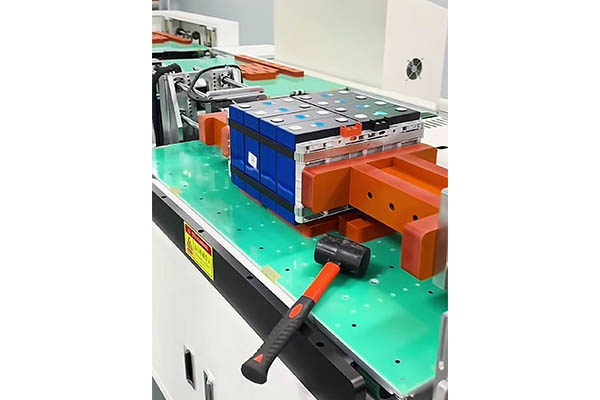
Cells in the same module must come from the same supplier and the same production batch, and the internal resistance difference is strictly controlled within 0.08mΩ. Module assembly adopts CNC high-precision positioning fixtures, busbars are welded by automated equipment, and DCIR testing is performed group by group after welding. Unqualified modules are directly rejected off the production line.
The SMT and potting of BMS circuit boards are completed in an independent electronic workshop, and the program needs to go through high and low temperature aging cycle verification and waterproof testing after programming. In the final assembly process, the module, BMS, wiring harness, and box are fastened and assembled in sequence according to the work instruction, and the bolt torque is recorded in real time by a digital display wrench and uploaded to the MES system.
Finished batteries sequentially pass insulation withstand voltage test, IP65 spray test, sine sweep vibration test, high and low temperature cycle test, and extrusion test, simulating the real load conditions of golf carts in scenarios such as bumpy fairways and temperature-differentiated outdoor environments. The factory data of each battery generates an independent electronic file, and users can trace the full production chain information through the product QR code.
This manufacturing system directly supports EA ENERGY to provide OEM supporting services for EZGO. When EZGO launches lithium battery configuration options for a new generation of golf carts and sightseeing shuttles, EA ENERGY can participate in the battery compartment data freezing at the design stage, simultaneously provide shell 3D models and electrical interface definitions, and the products are directly delivered as original batteries with the complete vehicle. For the EZGO existing in-service market, the EA51120S is also molded strictly in accordance with original specifications, and the connector models, locking mechanisms, and drainage groove structures are completely consistent with the original vehicle lead-acid battery pack, achieving seamless connection for secondary assembly.
The operation process of installing the EA51120S on an EZGO golf cart is clear and standardized, but it must be strictly followed to ensure safety.
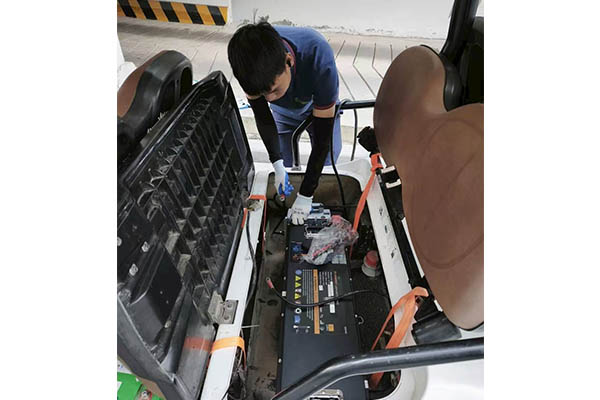
First, park the vehicle on a flat work area, turn off the key switch, and disconnect the main power switch of the vehicle. Conventional lead-acid battery packs are heavy and need to be taken out with the assistance of a manual pallet jack or small lifting equipment; the EA51120S weighs 65kg, which can be easily carried manually and placed smoothly by aligning with the positioning holes.
Pay attention to the installation direction when placing the battery into the compartment: the connector side should be aligned with the vehicle wiring harness outlet, the positive and negative electrode markings correspond one-to-one with the original vehicle wiring harness, and the pole marks are screen-printed on the battery top cover. Push the plug firmly until the lock is snapped into place, then tighten the communication docking socket. It is not recommended to start the vehicle immediately at this time. First check whether the battery fixing bolts are fully inserted into the bottom plate positioning holes, and tighten them to the specified torque with a torque wrench.
Power-on wake-up can be completed by short-pressing the BMS panel button. When the battery indicator changes from flashing to steady on, it means the self-check is completed. For the first installation, it is recommended to wake up the entire system through the charger first, connect the charger output terminal to the battery charging port, and the BMS will automatically close the MOS tube after recognizing the charging handshake signal, and light up the status display at the same time.
Conduct a test run after full charge, and observe whether the battery level change on the instrument is continuous and without jump during driving and hill climbing. If the original vehicle battery meter has display jump problems, it can be adapted by fine-tuning the voltage divider resistor network of the BMS signal output module. EA ENERGY’s global service teams are equipped with dedicated matching boards, which can complete on-site commissioning in no more than half an hour.
The core advantage of conventional lead-acid batteries on EZGO models is low initial purchase cost, mature technical route, and a complete recycling and smelting industry chain. However, its shortcomings are equally prominent: a single charge takes 8 to 10 hours, and spare batteries must be equipped for rotation during peak operation periods; water replenishment maintenance is required every month, and improper electrolyte level control can easily cause plate sulfation; the acid mist released during charging will corrode vehicle frame metal parts and golf course charging facilities; capacity drops sharply in low-temperature environments, and winter range often shrinks by more than 30%.
The cycle life of LFP batteries can generally reach more than 5000 cycles, and the capacity retention rate can still be maintained above 80% after full charge and full discharge. For operation scenarios with one charge per day, this means a service life of more than 8 years.
In terms of charging efficiency, the coulombic efficiency of lithium battery charge and discharge exceeds 95%, while that of lead-acid batteries is about 80%. Under the same nominal capacity, the actual available energy of lithium batteries is nearly 15% higher. The maintenance-free feature can directly save the expenses of dedicated operation and maintenance personnel, distilled water procurement, and acid mist corrosion repair. The significant weight reduction reduces driving energy consumption, further extending the single-charge range; the temperature control design of low-temperature heating and high-temperature heat dissipation allows the battery to maintain stable output in different environments throughout the year, without the need to compensate for low-temperature attenuation by increasing capacity like lead-acid batteries.
For customers with old lead-acid batteries, EA ENERGY provides a complete trade-in solution: on-site disassembly of old batteries with trade-in discount service, simultaneous completion of EA51120S installation and commissioning and charger matching. The recycled old lead-acid batteries enter the closed-loop recycling production line, and the plate regenerated lead flows back into the industrial battery manufacturing cycle. This model also meets the ESG report disclosure requirements of global golf courses and cultural tourism enterprises.
EA ENERGY has built a service network covering major cultural tourism and golf industry regions around the world, with authorized service centers and spare parts warehouses in core markets such as North America, Europe, Southeast Asia, and Oceania, which can cover local golf cart lithium battery troubleshooting, BMS diagnosis, equalization repair, and whole pack replacement services.
For scenic areas, resorts, and tournament golf courses with seasonal peak operations, a lithium battery leasing solution is launched. EZGO matched with EA51120S can be billed monthly or quarterly, and the charger is delivered synchronously with the battery. After the contract expires, the equipment will be refurbished and recovered.
The leasing model also provides lead-acid battery options. Customers can continue their original lead-acid usage habits, and EA ENERGY provides full managed services such as regular water replenishment, equalization charging, and capacity testing. This flexible dual-technology route allows users to avoid making an either-or choice between technological iteration and budget constraints, and can flexibly adjust power configurations according to the fluctuation rhythm of passenger flow. For example, when a tourist resort temporarily expands its shuttle fleet during the peak season, it can directly allocate lithium battery modules and charging piles from the regional spare parts warehouse, complete all commissioning within 3 working days, and return the equipment after the peak season, only billing according to the actual usage months.
For cross-border delivery customers, each batch of EA51120S is accompanied by complete compliance documents, including UN38.3 test report, MSDS chemical safety data sheet, transport hazard appraisal report (covering sea, land, and air transport), dangerous goods classification appraisal report, and dangerous goods packaging certificate. It also has international certifications such as CE and UL, and can be smoothly circulated to major markets around the world. The complete compliance system supports products exported to core scenarios such as North American golf courses, European resorts, and Southeast Asian cultural tourism parks.
EA ENERGY has profound OEM supporting accumulation in the field of light industrial vehicle lithium batteries, and its complete system design capability is in the first echelon of the industry.
The cell supply chain locks in first-tier brand resources, and even in the face of industry capacity fluctuations, it can ensure the stable supply of automotive-grade A-grade cells. The independently developed BMS protocol adaptation library has covered the communication protocols of multiple brands of golf carts such as EZGO, Club Car, and Yamaha, and can quickly match the original vehicle instruments, chargers, and on-board computer systems.
The long-term experience in supporting the full EZGO model lineup enables EA ENERGY to deliver dedicated batteries to the standard of "out of the box as original": the shell size tolerance is controlled within ±0.5mm, the pole position is completely consistent with the lead-acid battery, the hardness of the foot buffer pad matches the original vehicle shock absorption parameters, and even the ventilation and heat dissipation structure is reserved corresponding to the original vehicle ventilation position. This is essentially an OEM-grade product delivery, not an ordinary aftermarket modification part.
In addition to mainstream EZGO models, EA ENERGY can provide original lithium battery solutions for a full range of light vehicles such as golf carts, sightseeing shuttles, and patrol cars, covering the full voltage platform from 24V to 72V. OEM customers can customize nameplate silk screen printing, box color matching, and communication protocols, and EA ENERGY’s engineering team can deliver functional prototypes within 20 working days after project initiation. ODM cooperation can go deep into the joint development of the vehicle electrical architecture, such as low-temperature auxiliary power supply strategy, dual-gun fast charging interface reservation, fleet management data docking, etc., which has long gone beyond the scope of a simple battery supplier.
The AC220V/DC58.4V 30A smart charger matched with the EA51120S has built-in temperature compensation and reverse connection protection functions, supporting both wall-mounted and floor-standing installation methods. The outdoor version can reach IP54 protection rating for open-air installation.
During charging, the cabinet display screen cyclically displays the current voltage, current, charged capacity and fault codes in real time. If the battery temperature is higher than 45℃ before charging, the BMS will send a delayed start command to the charger, and then connect to charge after natural cooling or forced air cooling to a safe threshold. This thermal management coordination mechanism effectively reduces the risk of cell thermal runaway, and is suitable for summer outdoor high-temperature scenarios.
In daily use, operators only need to pay attention to the battery meter to avoid deep discharge, and check the plug fastening status and box appearance cleanliness once a month, without additional maintenance operations.
During the warranty period, EA ENERGY provides on-site equalization maintenance service every six months, reads the internal operation log of the BMS, evaluates the evolution trend of each series of voltage differences, and issues early warnings and arranges replacement for backward cells in advance. This proactive operation and maintenance mode intercepts faults before user perception, which is the core difference between OEM-grade service and ordinary battery sales.
For the energy efficiency metering and fleet management needs concerned by operating enterprises, EA ENERGY can open the BMS data interface, directly connect to the park energy management system and fleet scheduling platform, and accurately record the energy consumption data, driving mileage and carbon emission reduction of each charge and discharge. This function can quantify the green transformation results and meet the annual report disclosure needs of zero-carbon scenic areas, high-end golf courses, and listed cultural tourism enterprises.
EA ENERGY maintains production capacity for both lithium battery and lead-acid battery technology routes, which makes the service flexibility for EZGO users far exceed that of suppliers with a single technology route.
Customers can adopt a mixed configuration scheme of "some vehicles upgraded to lithium batteries and some vehicles retaining lead-acid batteries", and deploy differentially according to usage scenarios, operation intensity, and operator habits. The daily maintenance of lead-acid batteries can be undertaken by EA ENERGY as an outsourcing service, saving enterprises the cost of building their own maintenance teams; lithium battery vehicles can enjoy all-inclusive services through lease contracts.
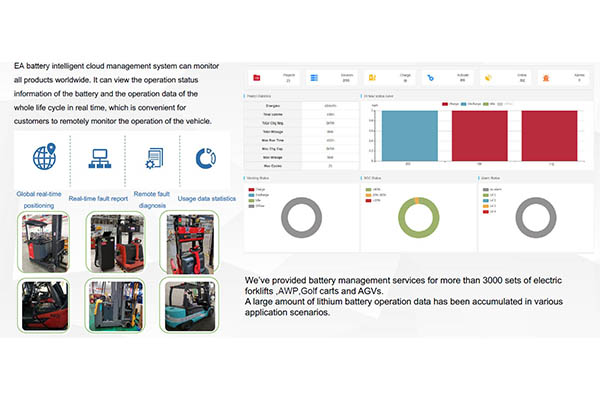
The global service network adopts a grid layout, with direct service points and authorized partners set up in each core region to ensure the response time for local customers. If the battery fails during the warranty period, the regional service center can deliver a spare battery within 4 hours, the faulty pack will be returned to the headquarters engineering department for disassembly and analysis, and the root cause analysis report will be fed back to the customer within two weeks. This grid guarantee system implements the certainty of battery services from the solution paper to the scheduling gaps of daily operations.
The power switch of EZGO golf carts from lead-acid to lithium is essentially a secondary optimization of labor costs, time efficiency, and asset cycles for golf course and park operations.
The EA51120S is not a simple model code; it carries a full set of capabilities including precise size meshing, seamless electrical adaptation, long-cycle durability, and global compliant delivery. With its 65kg lightweight design and original vehicle-level size adaptation, the upgrade process is efficient and modification-free. With automotive-grade cell supply chain, self-developed BMS technology, engineering accumulation of joint commissioning with EZGO, and a global service network, EA ENERGY has created a reliable powertrain solution for this classic golf cart.
For golf course operators and cultural tourism enterprises that are evaluating energy solution upgrades, the details of this solution are complete enough, and there is no need to weigh repeatedly between modification adaptation and compromise use. The next step is only to conduct an actual vehicle range and hill climbing test comparison, and then convert the benefit difference calculated on paper into real efficiency and cost optimization in the operation report.
 English
  Lithium Golf Cart Battery
  Low Speed Vehicle Battery
  Lithium Forklift Battery
  Aerial Work Platform Battery
  Floor Cleaning Machine Battery
  Lithium Marine Battery
  Residential ESS
  Commercial & Industrial ESS
  Truck Electrical System
  RV Electrical System